
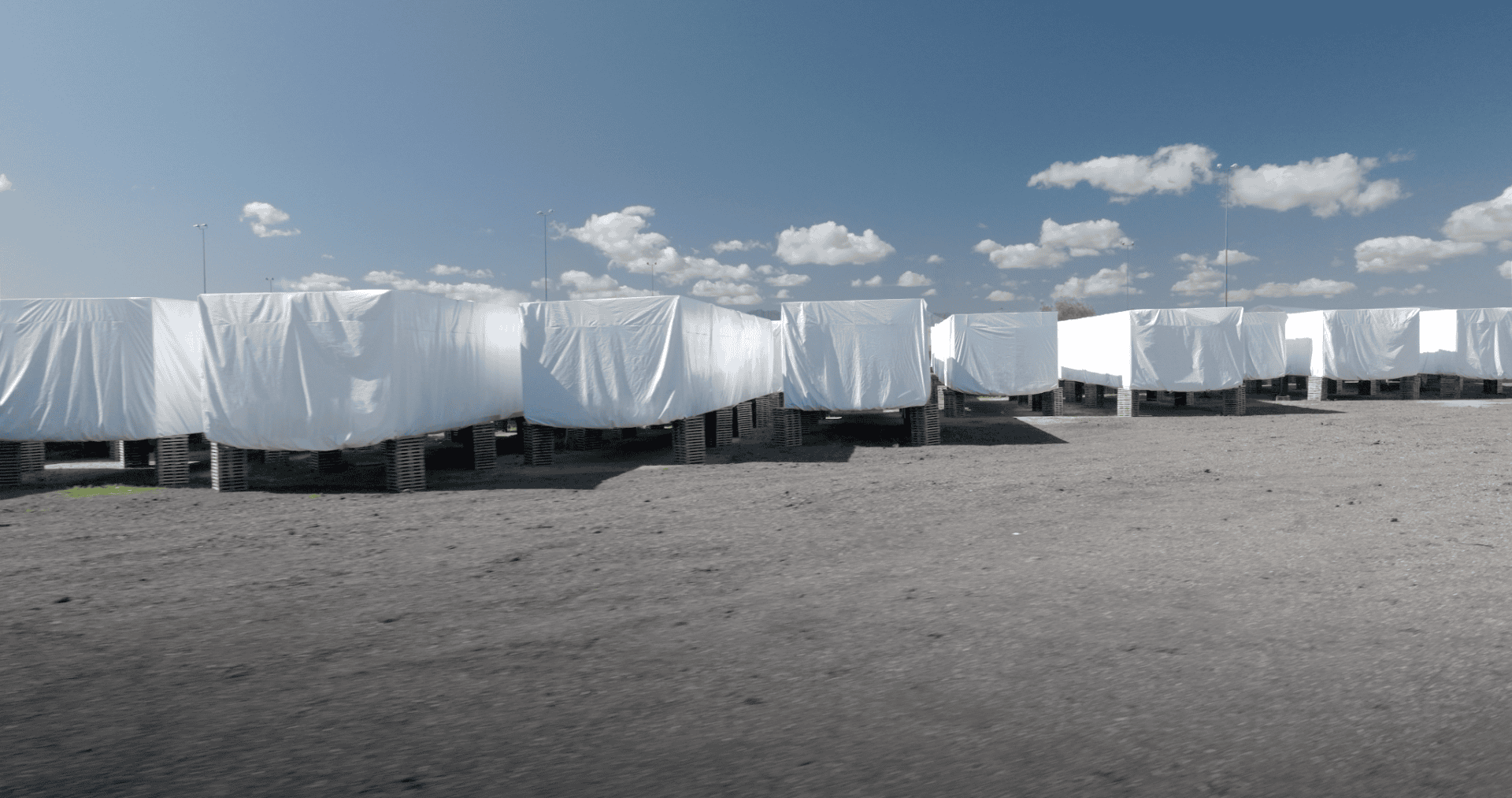
Manufacturers, OEMs, and distributors face the same problem no matter what they build: equipment has to survive storage and transit and show up ready to work. A wind turbine generator staged in a field, a Class A painted machine riding a flatbed, naval hardware waiting on installation, data center gear in transit. Each one sits exposed to moisture, UV, road debris, and the corrosion that follows.
Tarps, shrink wrap, and wood crating each have a place. But when corrosion control, product appearance, and lifecycle cost are on the line, custom-fit covers outperform the alternatives. Transhield’s own testing and field results back that up across every method buyers tend to evaluate. Below is how the options stack up.
How the Options Compare at a Glance
| Method | Fit | Effect on corrosion | Weather & UV | Access |
| Standard tarps | Loose, gaps and pooling | Traps moisture against metal | Limited, works loose | Re-tie each time |
| Single-use shrink wrap | Hand-fitted, installer-dependent | Condensation buildup inside | Moderate, puncture-prone | Cut to open |
| Wood crating | Rigid box, not contoured. Heavy Weight. | Wood acids may corrode metal | Good impact, weak weather seal | Pry open |
| Transhield custom covers | Engineered to the asset | Up to 95% reduction with Vapor Corrosion Inhibitors | Shrink-to-shape, UV-screening, flexible packaging. | Zippered doors and flaps |
The table is the short version. The detail is where the real differences show up.
Transhield vs. Tarps
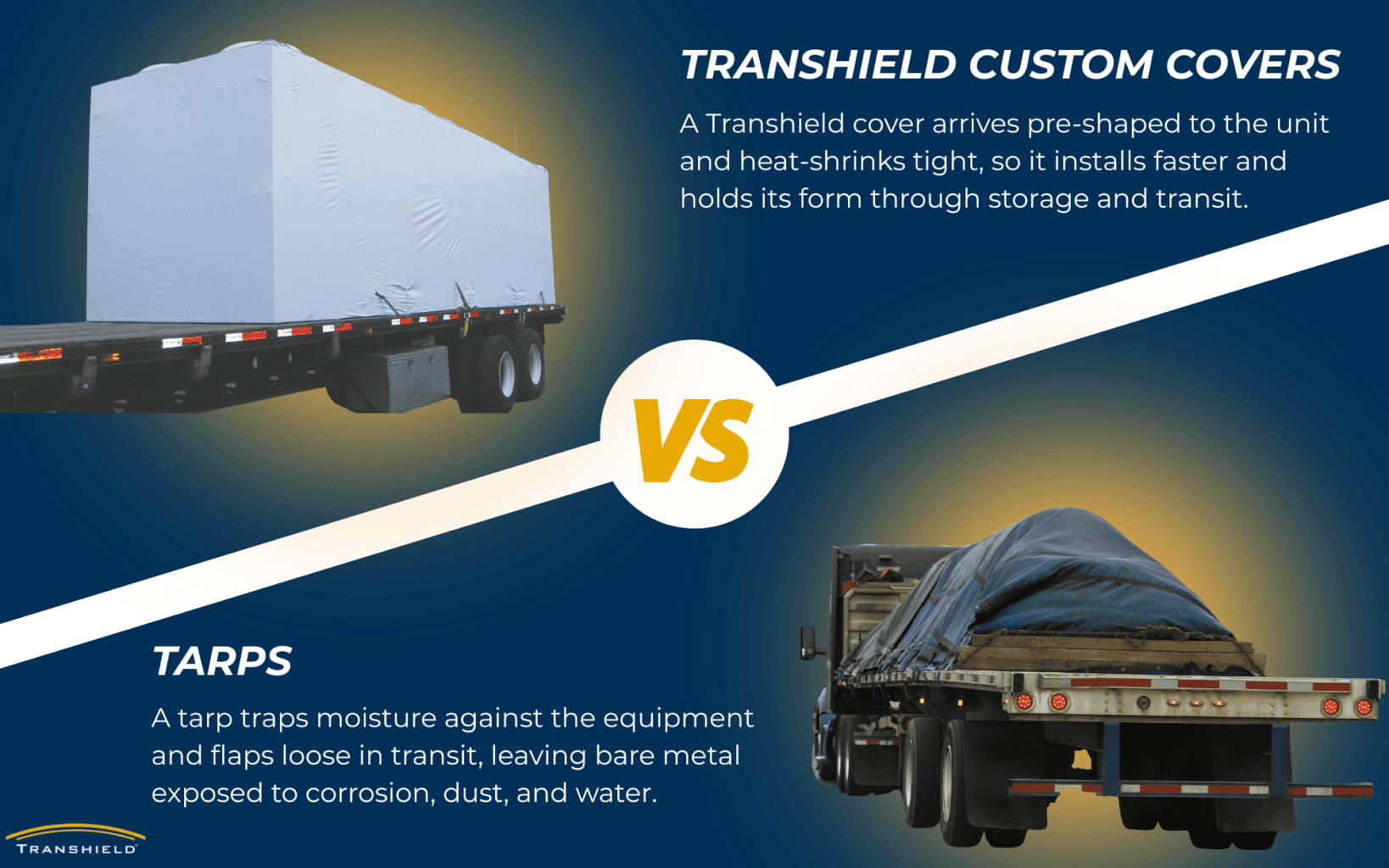
A tarp is the cheapest and most available option, which is why it stays common on flatbeds. It is also the least protective.
Where tarps fall short
- Moisture gets trapped against the equipment, with nothing to slow the corrosion that follows.
- A loosely fitted tarp flaps in the wind and lets in dust and water.
- The cover is heavy and awkward to apply, with no built-in way to access the unit.
- If the tarp is supplied by the trucking company, the asset is unprotected before and after shipping; that may lead to damage and warranty claims.
Once that surface quality is compromised, repair and rework costs climb fast, and the cheap option turns into an expensive one.
What Transhield delivers
A Transhield cover is engineered to the unit and brings what a tarp cannot:
- Pre-shaped fit that installs faster and with less effort
- Heat-shrink that pulls tight and holding form through storage and transit
- Snug profile that lets you compress loads and fit more per trailer
- Lightweight handling that keeps crews off the top of the load
- Soft inner layer that wicks condensation away and shields painted or machined surfaces
- Built-in zippers, sight windows, Velcro doors, and tie-downs for access without uncovering
- Clean, professional appearance on arrival instead of road-worn
- Covers that start protection as the product leaves the facility and provide full protection even after delivery takes place.
- No carrier tarping service, and no per-load tarping fees
For loads that have to arrive ready instead of road-worn, a fitted cover earns back its cost long before a tarp does.
Transhield vs. Shrink Wrap
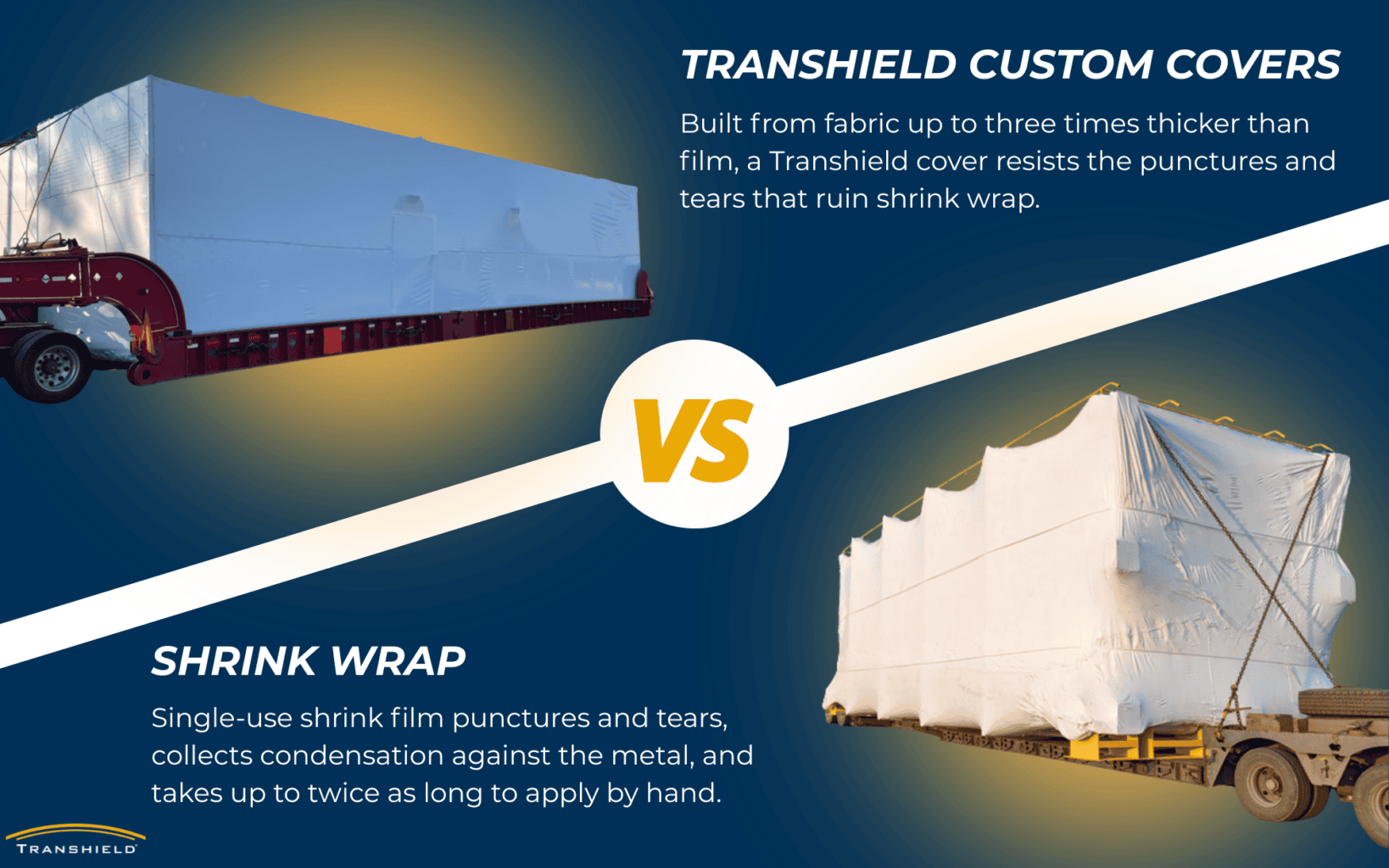
Shrink wrap solves the loose-fit problem tarps have. However, it trades it for a different set of issues.
Where shrink wrap breaks down
- The thin, single-use film punctures, rips, and tears easily.
- Heat from the shrinking step can transfer onto the product underneath.
- Condensation collects on the inner surface and invites corrosion and mold.
- Hand application is slow, often taking up to twice as long as a pre-fit cover.
- Also requires extensive use of packaging tape, which adds to the cost.
Because each wrap is hand-cut, folded, and taped on site, the fit and the true cost per unit ride on whoever is running the heat gun that day.
What Transhield delivers
Swap the wrap for a cover built to the unit, and every weak point above turns into a strength:
- Goes on fast and seats tight to the unit the first time
- Skips tape entirely, so nothing sticky transfers onto the product
- Fabric up to three times thicker than film, resisting the punctures and tears film cannot
- Gentle against fine finishes, with no scratching or etching
- Moves condensation out instead of trapping it against the metal
- Add zippers, windows, velcro doors, and tie-downs wherever access is needed
- Up to 50% faster to apply, which increases production output
- A cleaner, more professional look than shrink film
Shrink film can get equipment down the road, but a Transhield cover is engineered to the asset, so every unit gets the same fit no matter who applies it. That consistency, plus built-in corrosion protection, makes it the steadier choice for repeat production runs.
Transhield vs. Wood Crating
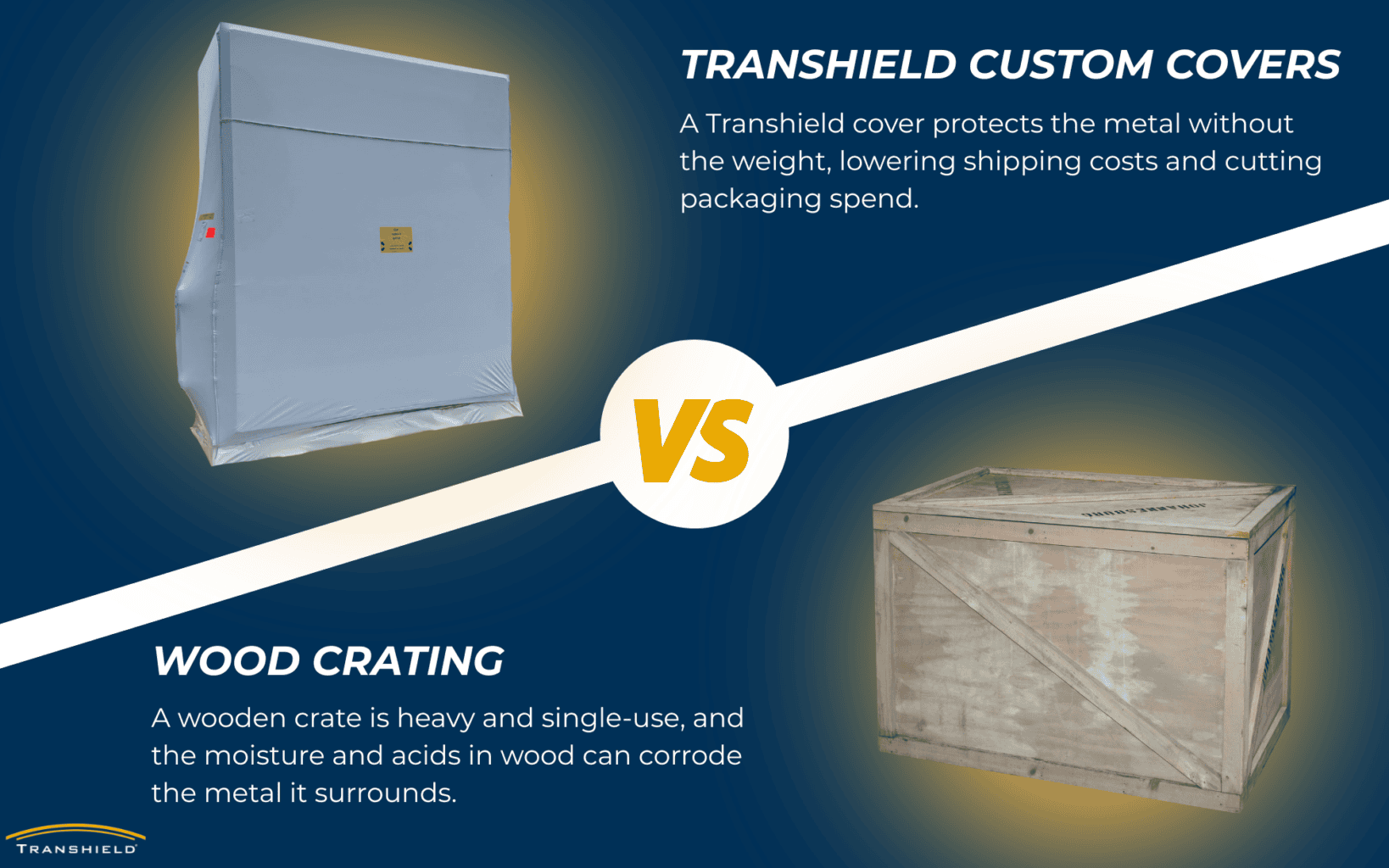
Crates go the other direction from tarps and film: strong against impact, but a liability for the metal inside.
Where crates fall short
- Wood holds moisture and gives off acids that corrode the metal inside.
- A wooden crate is heavy, which raises freight cost.
- The crate is single-use bulk that gets broken down and discarded, leaving disposal work for the receiver.
- Typically not weather-proof against dust and rain.
- If the crate is opened for inspection at delivery, the product may not be as protected after delivery.
What Transhield delivers
Swap the crate for a fitted cover, and the advantages add up quickly:
- A large reduction in packaging spend versus building and tossing crates
- Simple handling and application, with none of the assembly a crate demands
- No water retention against the equipment
- No acids to corrode the metal the cover surrounds
- Vapor corrosion inhibitors built into the Transhield fabric to slow corrosion from the inside
- Lower overall shipping weight than a heavy wooden box
- Zippers, windows, velcro doors, and tie-downs for access, with no box to pry open
Crates still make sense when impact is the main threat. Otherwise, a Transhield cover delivers the protection a crate is reaching for, without the weight, the disposal pile, or the wood chemistry working against the metal.
The Real Difference: Corrosion Control
Look back at all three options and the same gap shows up: none of them protect the metal itself. They are barriers at best, and at worst they trap the moisture and acids that start corrosion.
This is where Transhield is built differently. Covers can carry Vapor Corrosion Inhibitor (VCI) additives that actively slow corrosion on the equipment inside. For asset preservation, a VCI is the recommended approach, not an add-on to skip.
How VCI works
The inhibitor releases molecules that move through the space inside the cover and settle on metal, forming a thin layer that blocks moisture and oxygen.
| Stage | What happens |
| Release | VCI molecules vaporize from the source material |
| Migration | These molecules travel through the enclosed space |
| Adhesion | VCI vapors bond with metal surfaces upon contact |
| Protection | A molecular layer forms, blocking moisture and oxygen |
The three-layer system
Transhield’s three-layer system with patented adhesive that emits VCIs carries it out:
- Outer layer: UV-resistant film that blocks sun and repels water
- Middle layer: hot-melt adhesive that holds the VCI chemistry
- Inner layer: soft non-woven that wicks moisture away and releases the VCI as vapor
In lab and field testing, covers containing VCI additives have reduced corrosion by up to 95%, even in high humidity.
The Cost That Actually Matters
Protection like that costs more than a tarp up front, and that is usually where buyers hesitate. But line-item price is only part of the math. A tarp or single-use wrap looks cheaper per unit, while the bill arrives later in corrosion repair, warranty claims, and rework.
A custom cover may cost more upfront and earns it back over the life of the asset through less corrosion, fewer touch points, and predictable per-unit pricing. Our custom fit design process builds each cover to the exact unit, so protection matches the product instead of a generic size.
Trusted Across Industries
That math holds across the many industries Transhield serves: aerospace and aviation, wind energy, data center, industrial machinery, rail and locomotive, marine, military applications, and more. The same system adapts to each.
- Custom fit engineered to the exact asset, with access and fastening built in
- Optional VCI additives that cut corrosion by up to 95%
- Produced under a quality management system certified to ISO 9001:2015
- 97.4% customer retention over more than 30 years
- Berry Amendment compliant, with all Transhield military covers made in the USA
Protect What You Built
Across every one of those industries, the protection method is part of the product you deliver. Transhield builds custom-fit, corrosion-fighting covers that hold up through storage and transit, so equipment arrives the way it left the line. Contact Transhield today to talk through a solution for your application.