
Most freight fits a routine. It sits on a pallet, slides into a crate, and travels under a standard cover. Oversized and oddly shaped equipment breaks that routine. Wind turbine components, gantry crane arms, construction equipment, and custom industrial machines don’t fit standard packing supplies. They have odd angles, exposed parts, and dimensions that push past what standard packing supplies can handle. This guide covers how to protect that equipment during storage and transit, and what to look for in a cover.
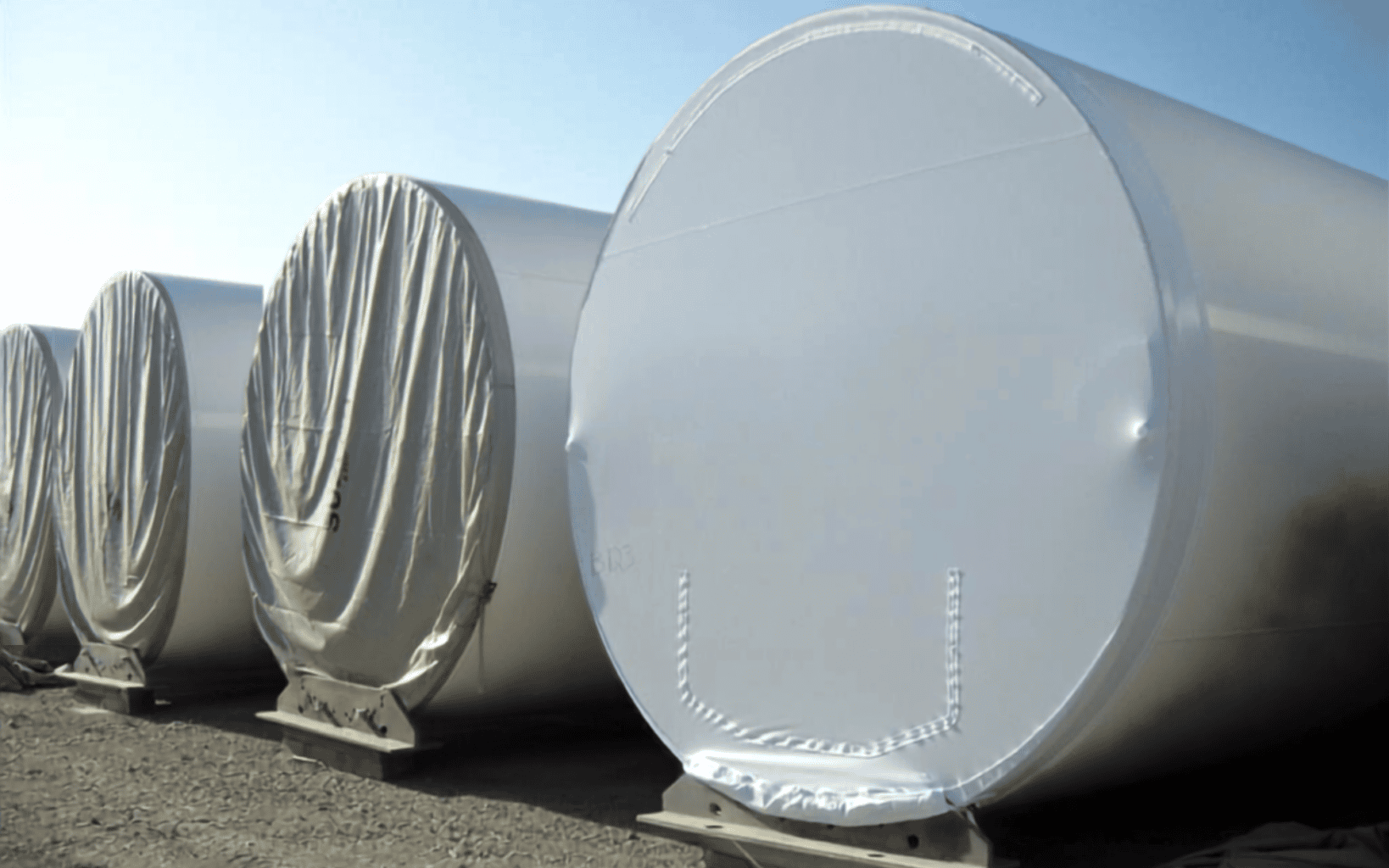
What Makes This Equipment Hard to Protect
A few traits set oversized and oddly-shaped items apart from standard freight:
- Size: Large equipment often qualifies as an oversized load, which affects how it ships and what covers it. A standard trailer may not be the right fit, and neither is a standard cover.
- Shape: Protruding arms, brackets, long steel beams, and angled surfaces create wear points and gaps that generic covers cannot follow.
- Exposed components: Sensors, hydraulics, and painted panels sit out in the open, where weather exposure does the most damage.
- Weight and value: Heavy equipment carries a high replacement cost, so damage during a single move can wipe out a project’s margin.
The Risks of Skipping Protection
Leaving oversized equipment uncovered, or covered poorly, opens the door to several problems.
| Risk | What Causes It |
| Corrosion | Moisture, salt, and humidity reaching bare metal |
| Surface damage | Road debris, dust, and abrasion during transport |
| UV degradation | Sun breaking down paint, rubber, and plastic components |
| Water intrusion | Rain and snow pooling in gaps and recessed areas |
| Warranty issues | Damage that shows up on delivery and delays acceptance |
For a manufacturer shipping industrial equipment across the United States or storing machinery between builds, any one of these can turn into a warranty claim or a rejected shipment.
Protecting Equipment During Transport
Oversized loads travel on specialized trailers. A flatbed truck works for some, while taller or heavier items ride on a lowboy trailer or double drop trailer that lowers the deck height. Covering it is a separate step that matters just as much.
On an open trailer, heavy loads face road salt, wind-driven debris, and quick weather changes. A cover that fits loosely will flap, tear, or blow off at highway speed, which creates safety hazards for nearby drivers. Transhield covers are sized to the shape and secured at defined anchor points, so they stay put through the trip.
For transport, look for:
- A snug fit with no loose material to catch wind
- Secure fastening, such as ratchet straps, at defined anchor points
- Reinforced wear points where the cover meets sharp edges or brackets
- Water-resistant fabric that keeps interiors dry through the trip
Protecting Equipment During Storage
Storage brings its own challenges, and it is where most of this equipment spends the bulk of its life. Industrial machinery may sit for weeks or months between transit and use. It often waits on a job site or at a storage facility, outdoors where weather exposure is constant. Removing the cover right after transit is a common mistake. The storage period can run longer than the trip itself, so the equipment usually needs to stay covered until it goes into service. Transhield covers are built to handle both stages, protecting equipment in transit and through long-term storage without swapping to a second solution.
For long storage, a good cover:
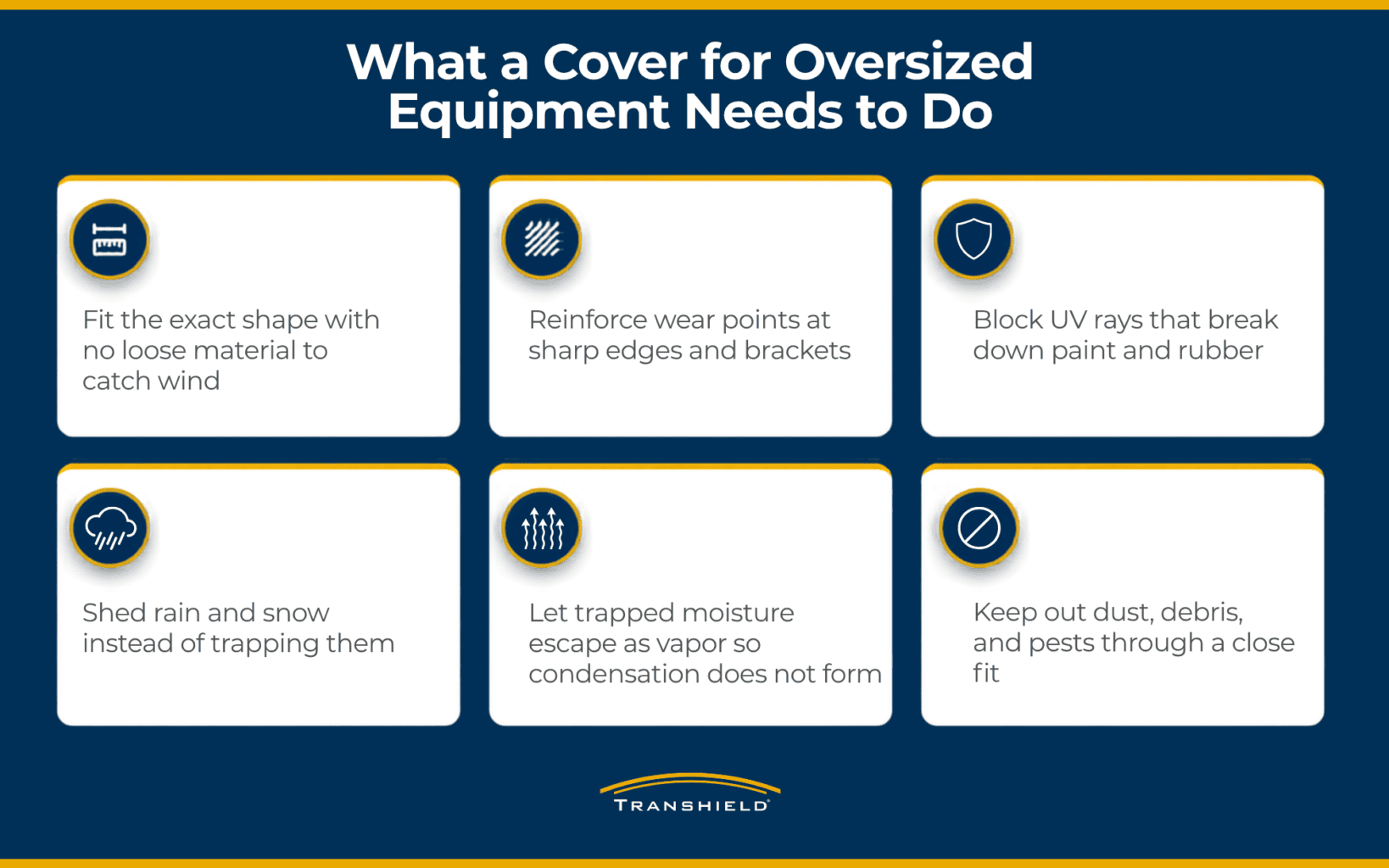
- Blocks UV rays that break down paint and rubber
- Sheds rain and snow instead of trapping it
- Lets trapped moisture escape as vapor so condensation does not form
- Keeps out dust, debris, and pests through a close fit
Common Protection Methods
Fabricated steel, construction materials, and finished machinery rarely fit a standard box. Packaging and purchasing teams weigh a few common options before settling on one, and each has limits with oddly-shaped loads.
| Method | Best Use | Limit with Oversized Loads |
| Custom crating | Smaller parts and fragile assemblies | Cost and bulk climb fast at large sizes |
| Stretch wrap | Palletized, boxy loads | Follows flat sides, not odd angles |
| Shrink wrap film | Short-term weather barrier | Thin film tears on sharp edges and brackets |
| Generic tarps | Quick, low-cost cover | Traps moisture and leaves gaps |
| Custom covers | Long-term storage and transit | Higher upfront cost than a tarp |
For assets that stay in inventory for months, a heavy-duty protective cover built to the shape usually gives the best return.
Why Custom Covers Fit Oddly-Shaped Equipment
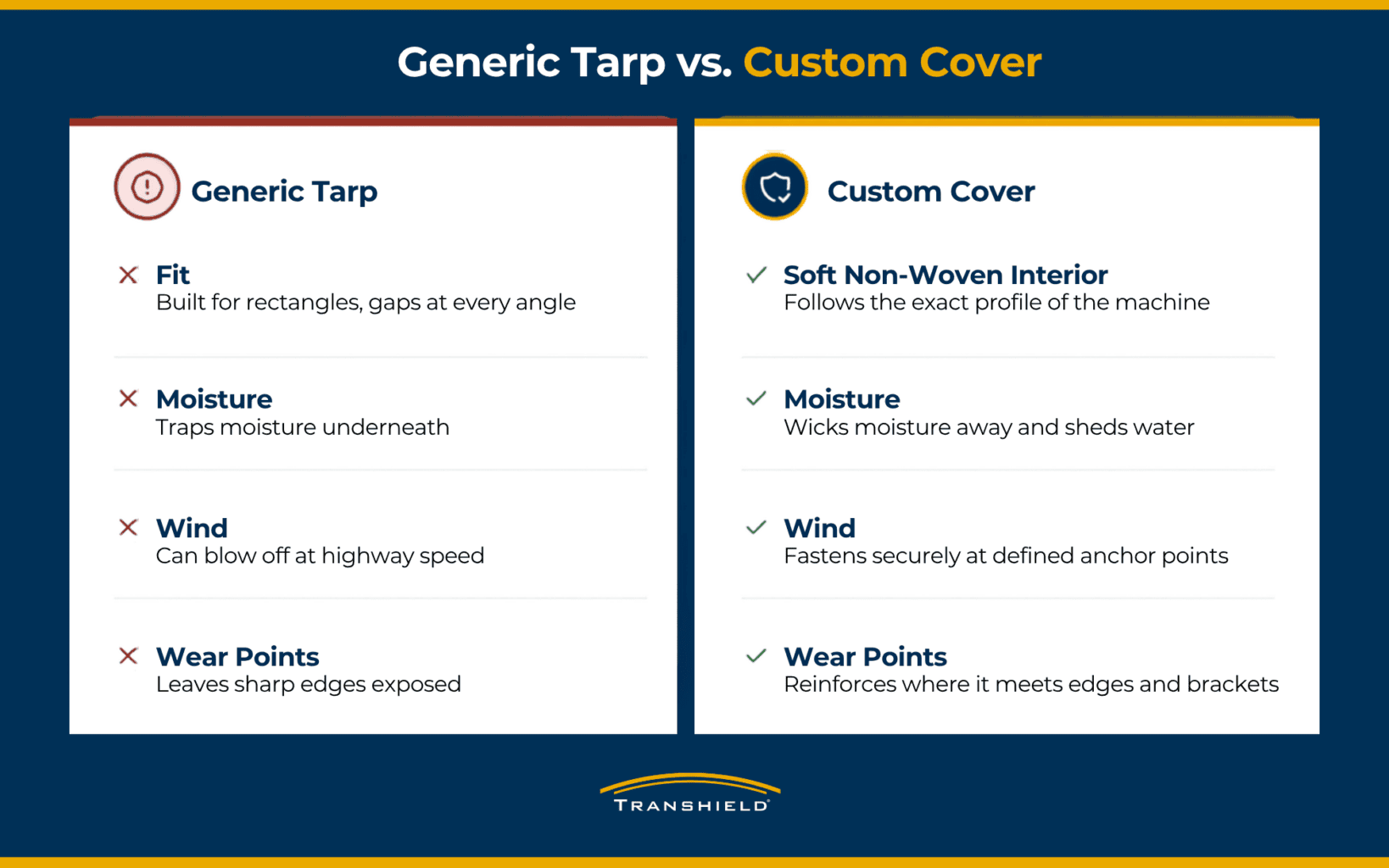
Generic tarps and standard covers are built for rectangles. Oversized and oddly-shaped items rarely cooperate. A tarp thrown over an irregular machine leaves gaps at every angle, and those gaps are where water, dust, and corrosion start.
Custom covers are designed around the specific piece. At Transhield, our Data Acquisition and Design teams measure the equipment and build a cover with no limitation on shape or size. The design strengthens wear points, works around access needs, and follows the real profile of the machine instead of draping over it.
Custom covers use a three-layer system:
- Outer layer: UV-resistant polyethylene film that blocks sunlight and repels water
- Middle layer: a hot-melt adhesive, with an option for patented adhesive that emits VCIs to fight corrosion
- Inner layer: a soft, non-woven material that wicks moisture away and protects painted surfaces
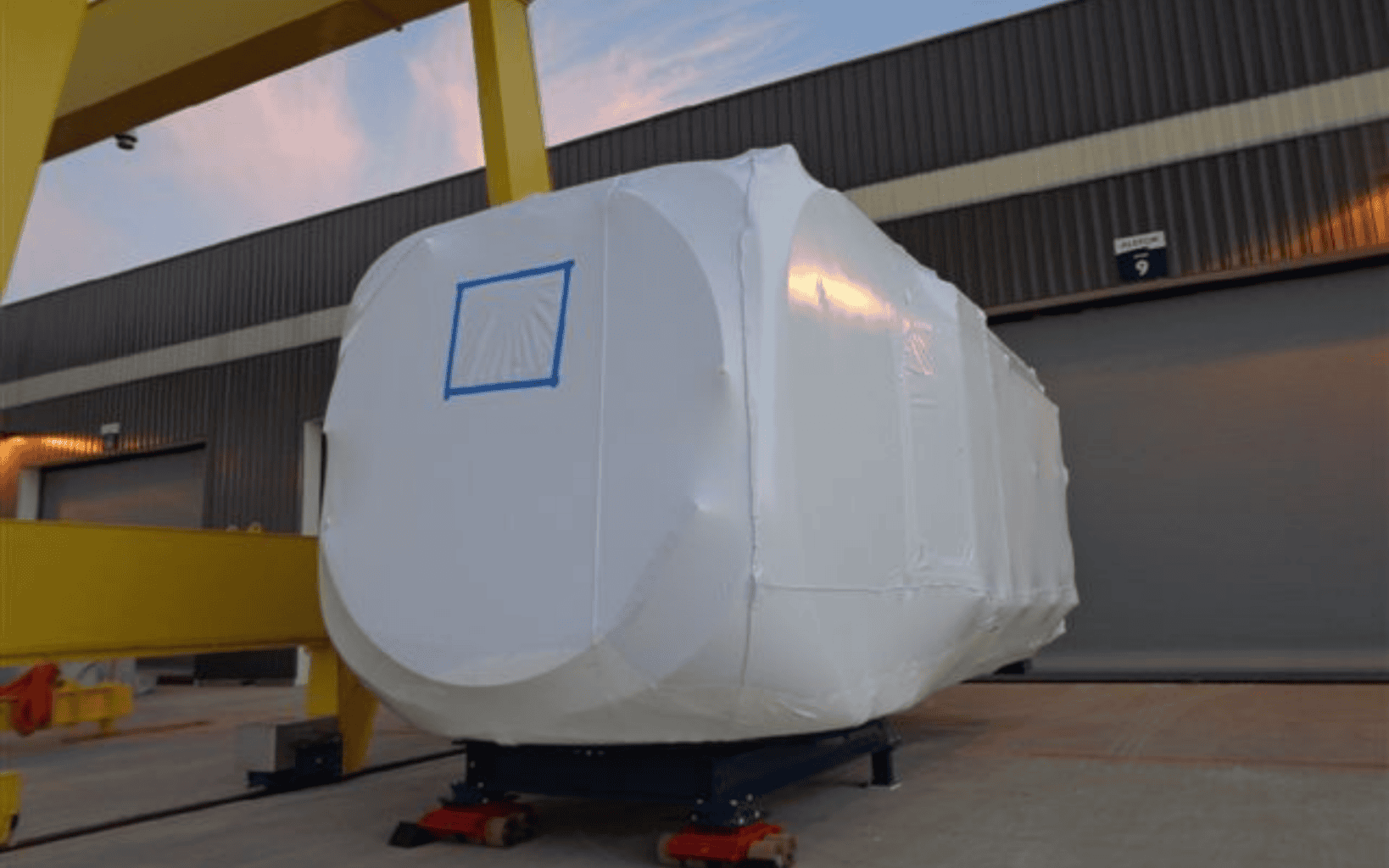
Some covers use a shrinkable fabric that heat-shrinks to the shape of the equipment, giving a snug, aerodynamic fit that repels snow and water in storage.
Fighting Corrosion on Metal Components
Corrosion is the quiet threat during long storage and transit, and oversized equipment has plenty of metal surface to protect. For corrosion protection, covers containing VCI additives are best. VCI stands for Vapor Corrosion Inhibitor, a technology that slows corrosion by keeping a concentration of protective molecules in the space around the metal. Because it works as a vapor, it reaches recessed areas and complex shapes that a brushed-on coating would miss, which is a real advantage on oddly-shaped equipment. The protection builds in four stages:
- Release: VCI molecules vaporize from the source material
- Migration: the molecules travel through the enclosed space
- Adhesion: the vapors bond with metal surfaces on contact
- Protection: a molecular layer forms, blocking moisture and oxygen
Transhield’s three-layer system holds the VCI away from direct metal contact so the molecules vaporize at the right rate. Covers containing VCI additives have reduced corrosion by up to 95% in testing, and the protection lasts as long as the cover stays in place.
Getting the Right Cover for Your Equipment
Protecting oversized and oddly-shaped equipment comes down to careful planning. Match the cover to the shape, the metal, and the length of storage or transit. A few questions help point you to the right solution:
- What are the dimensions, and does the load ship on a flatbed, lowboy, or double drop trailer?
- How long will the equipment sit in storage after it arrives?
- Which surfaces are painted, and which are bare metal that needs corrosion protection?
- Where are the access points, brackets, and wear points a cover has to work around?
That custom fit is what Transhield builds. Our design team 3D scans your equipment and makes a cover that follows its exact profile, closing the gaps where corrosion, water, and debris start on odd angles and exposed parts. The same cover protects through transit and long-term storage, and covers containing VCI additives add corrosion protection for the metal underneath. Contact us today to find the right equipment cover for your oversized or oddly-shaped equipment.