
Rust, pitting, oxidation. Corrosion can quietly destroy expensive equipment while it sits in storage or travels cross-country. This guide walks through proven strategies to stop it before it starts.
Understanding Corrosion and Its Impact on Industrial Equipment
Corrosion is a natural process that breaks down metal surfaces through chemical reactions with environmental elements like moisture, oxygen, and salt. For manufacturers, logistics teams, and equipment owners, the impact of corrosion goes far beyond surface-level rust. It can compromise structural integrity, void warranties, delay projects, and drive up life cycle costs.
Industrial equipment faces unique corrosion risks during storage and transit.
- Equipment that is stored outdoors is exposed to environmental factors like rain, humidity, UV rays, and temperature swings.
- During transport on open trailers and flatbeds, equipment faces road salt, sea spray, wind-driven debris, and rapid temperature changes.
The good news? Corrosion is preventable. With the right corrosion management approach, you can keep equipment in factory-fresh condition until it reaches its final destination.
Common Types of Corrosion to Watch For
| Corrosion Type | What Causes It | Common Areas |
| Uniform Corrosion | Exposure to moisture and oxygen | Exposed steel and iron surfaces |
| Galvanic Corrosion | Contact between dissimilar metals | Joints where steel & brass, aluminum & stainless steel, or copper & iron meet |
| Pitting Corrosion | Localized breakdown in protective layers | Under surface pitting may cause deeper corrosion into a structure |
| Crevice Corrosion | Trapped moisture in tight spaces and lack of oxygen | Gaskets, seams, and overlapping surfaces |
Each type requires a slightly different prevention approach, but most strategies work by creating a barrier between the metal surface and corrosive elements.
Proven Corrosion Prevention Strategies
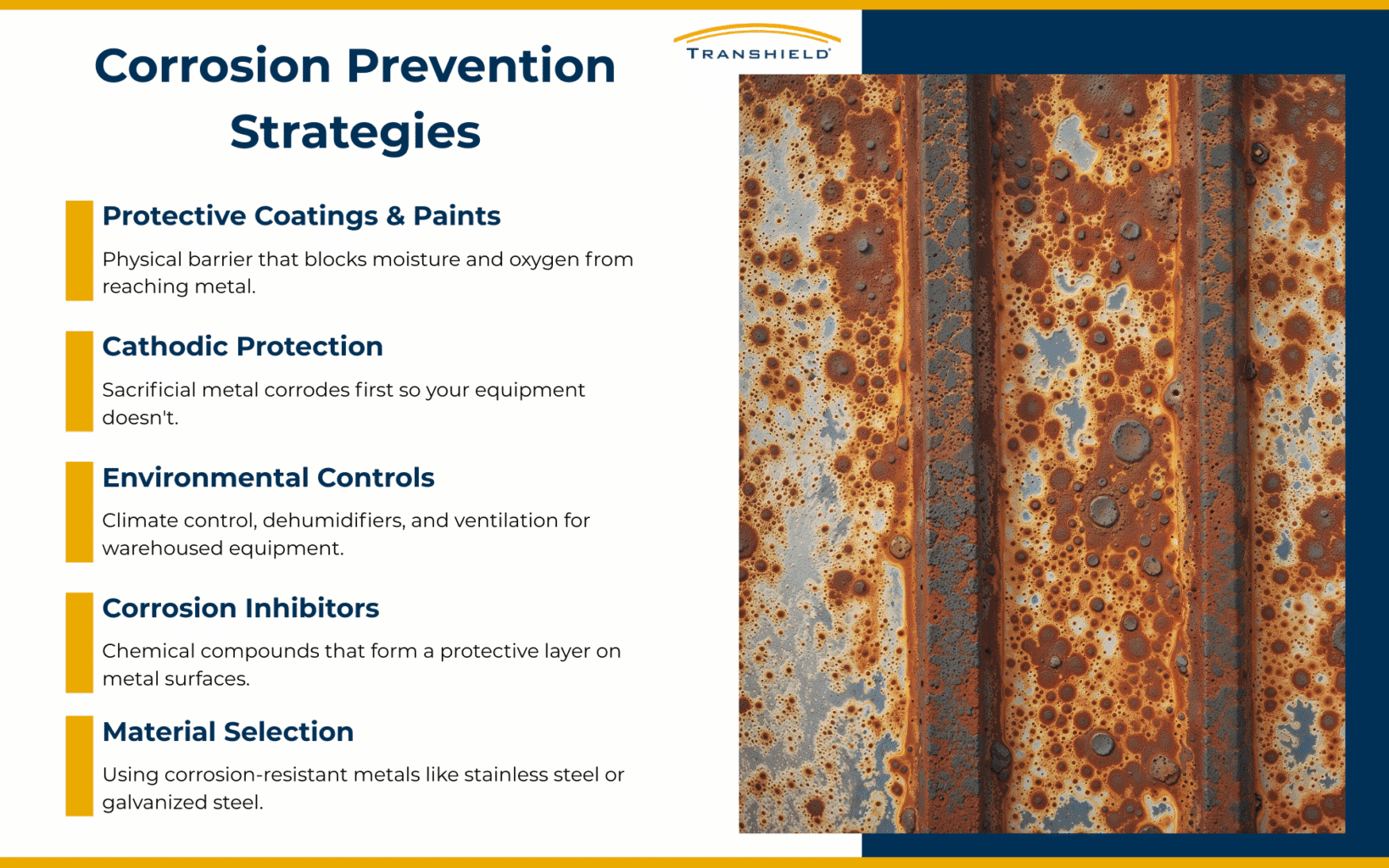
Protective Coatings and Paints
Applying a protective coating is one of the most common corrosion prevention methods. These coatings create a physical barrier that prevents moisture and oxygen from reaching the metal surface. Options include powder coatings, epoxy-based paints, zinc-rich primers, and specific corrosion prevention coatings designed for harsh environments.
The effectiveness of any resistant coating depends on proper surface preparation and application. Even small gaps can allow corrosion to start underneath.
Cathodic Protection
Cathodic protection works by attaching a more reactive metal to your equipment. This sacrificial metal takes the corrosion damage so your equipment doesn’t. It’s effective for stationary assets like pipelines and storage tanks, but less practical for equipment that moves frequently during storage and transit.
Environmental Controls
Controlling the environment around your equipment can significantly reduce corrosion risk through climate-controlled storage, dehumidifiers, and proper ventilation. These controls work well for warehoused equipment, but aren’t always practical for outdoor storage or transit where environmental factors are unpredictable.
Corrosion Inhibitors
Corrosion inhibitors are chemical compounds that slow the corrosion process by forming a protective layer on metal surfaces.
Vapor corrosion inhibitors (VCIs) are particularly effective for storage and transit applications. Unlike liquid-applied inhibitors, VCIs release molecules into the air that settle on metal surfaces and create an invisible protective barrier. This makes them ideal for protecting hard-to-reach areas and complex equipment shapes, offering continuous long-term protection without direct contact application.
Material Selection
When possible, choosing corrosion-resistant materials during design reduces maintenance needs. Options include stainless steel, aluminum, composite materials, and galvanized steel. Of course, material selection isn’t always an option when protecting existing equipment.
Custom Protective Covers: A Comprehensive Solution
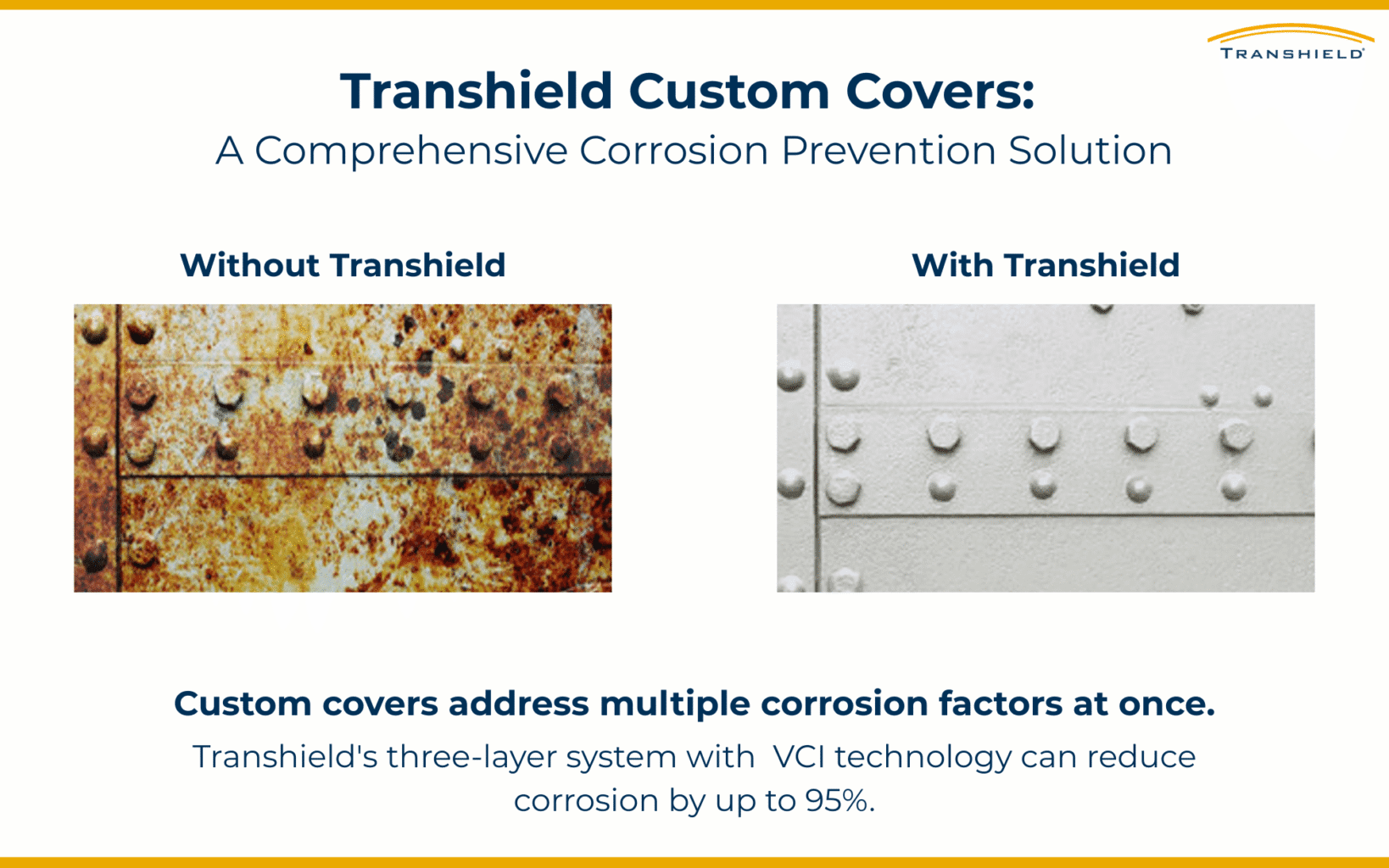
For equipment in storage and transit, custom protective covers address multiple corrosion factors at once. Unlike generic tarps, custom covers fit your specific equipment, providing complete coverage without gaps or stress points.
Transhield has spent over 30 years developing protective cover solutions for industrial, military, and commercial applications, combining physical protection with advanced corrosion-fighting technology.
How Transhield Covers Fight Corrosion
Transhield’s protective covers use a three-layer system:
- Outer layer: UV-resistant polyethylene film that blocks sunlight and repels water
- Middle layer: Patented Hot-melt adhesive with VCI additive technology that releases corrosion-inhibiting molecules
- Inner layer: Soft, non-woven material that wicks moisture away from equipment surfaces
For covers with VCI chemistry, this system can reduce corrosion by up to 95% in lab and field testing.
Key Features for Long-Term Protection
Transhield covers can be customized with features for specific storage and transit challenges:
- Shrinkable fabric that heat-shrinks for a snug, aerodynamic fit during transport
- Water-resistant construction that keeps interiors dry
- Breathable materials that allow trapped moisture to escape, preventing condensation
- Custom access points, including zipper doors and vents for inspections
- Secure fastening systems like ratchet straps
Because each cover is designed for your specific piece of equipment, there are no gaps where moisture or debris can enter.
Best Practices for Corrosion Control
The most effective corrosion prevention combines multiple strategies into a comprehensive control program.
Before storage or transit:
- Inspect equipment for existing corrosion or coating damage
- Clean surfaces to remove contaminants that accelerate corrosion
- Apply touch-up coatings to any exposed areas
- Install custom protective covers designed for your specific equipment
During storage:
- Conduct regular inspections to check for moisture intrusion or cover damage
- Monitor environmental conditions when possible
- Address any issues immediately before they spread
After transit:
- Inspect equipment condition and check covers for any damage from transport
- If equipment will remain in storage, ensure covers are properly secured and intact before leaving in place
- When ready for use, remove covers carefully and document any issues for quality assurance and warranty purposes
A proactive maintenance program catches small problems before they become expensive repairs.
Protecting Your Investment
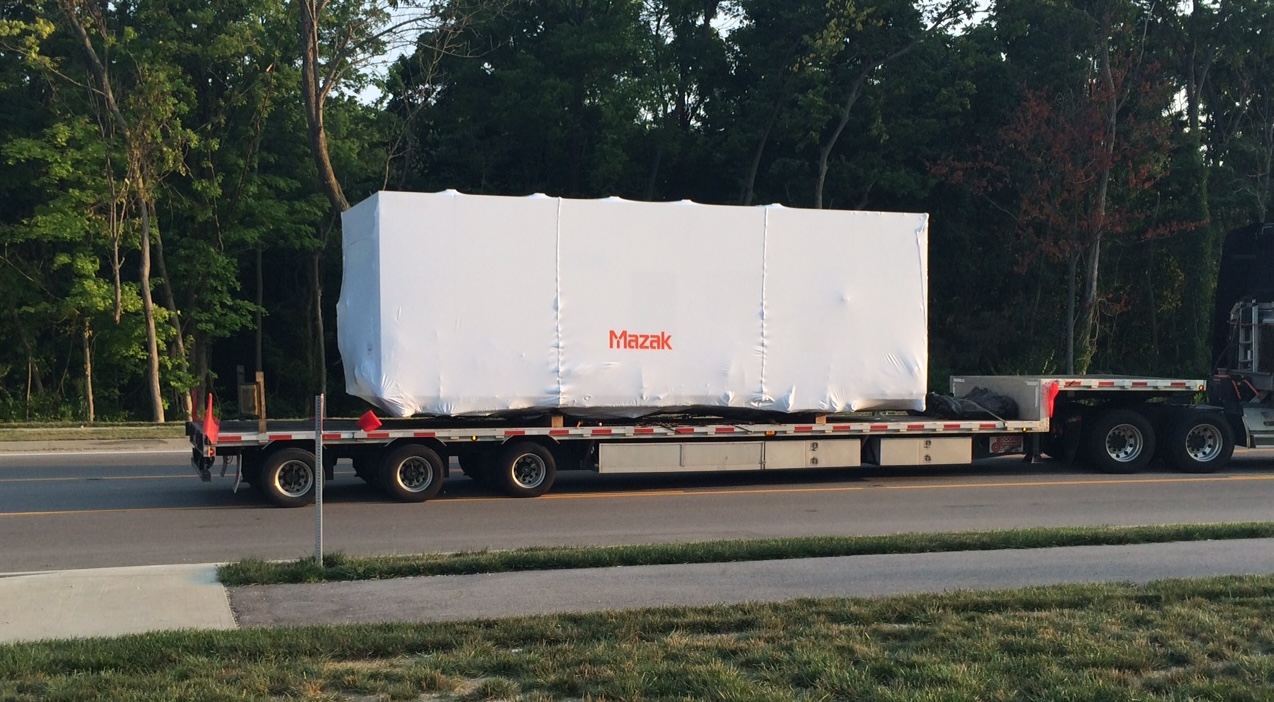
The cost of corrosion includes repair expenses, warranty claims, project delays, and damaged customer relationships. Investing in proper corrosion prevention upfront costs far less than dealing with the consequences later.
Custom protective covers from Transhield offer a practical, proven solution for keeping industrial equipment protected during storage and transit. With over 30 years of experience, ISO 9001:2015 certification, and a 97.4% customer retention rate, Transhield has the expertise to help you find the right corrosion protection for your specific needs.
Ready to protect your equipment? Contact Transhield today to discuss custom cover solutions for your application.