
Moving an oversized load is a different kind of job from standard freight. The permits alone can take days to sort out, the route has to be mapped around bridges and weight limits, and the piece of equipment riding on the trailer is often worth a small fortune. With that much on the line, protecting the machinery during the haul deserves as much attention as the logistics.
This guide covers what makes a load oversized, the permits and escorts involved, and how to keep your equipment in good condition from pickup to delivery.
What Counts as an Oversized Load
A load becomes oversized when the vehicle and its cargo exceed the legal dimensions set for normal travel. Push past the legal gross vehicle weight and it also becomes an overweight load. Many heavy hauls are both, which is why oversize and overweight permits are often issued together.
Here are the federal limits that apply on the Interstate Highway System and National Network, according to the Federal Highway Administration. Off these routes, and for height and length in particular, individual states set their own rules:
| Measure | Federal Limit |
| Width | 102 inches (8 feet 6 inches) |
| Height | No federal limit; states set 13.6 to 14.6 feet |
| Length | No federal limit on most tractor-semitrailers; states set the rules |
| Single axle weight | 20,000 pounds |
| Tandem axle weight | 34,000 pounds |
| Gross vehicle weight | 80,000 pounds |
Anything past these limits, or past a stricter state limit, needs a permit. Much of this freight is a non-divisible load, meaning it cannot be broken down into smaller pieces, like a single large machine, a transformer, or a mobile home. Because it cannot be split up, the only way to move it legally is with the proper permit and the right trailer.
Permits, Escorts, and Planning
This is where oversized load movement gets complicated. Every state sets its own rules, and a route that crosses several states may need a separate permit for each one.
Getting the Right Permit
Permits come in a couple of forms. An oversize permit covers a load over the legal size, and an overweight permit covers a load over the legal weight. A load that is both needs both. Most states issue them through their motor carrier services or transportation department.
A few common permit types:
- Single-trip permit: Covers one specific move along an approved route. Most oversize and overweight hauls use one.
- Annual permit: For carriers that move oversized loads regularly within set limits, an annual permit can cover repeat trips without a new permit application each time.
- Special permit: Required for loads that exceed even standard oversize thresholds, often with extra conditions attached.
The permit application asks for the load dimensions, gross weight, axle weight, route, and travel dates. Permit fees vary by state and by the size of the load.
Escorts and Routing
Larger loads come with an escort requirement. Depending on the dimensions, that can mean one or more escort vehicles, and in some cases a police escort coordinated with the local police department or other local authorities.
Routing matters just as much. An oversize vehicle has to avoid low height clearance at overpasses, weight-restricted bridges, and tight city streets. Many permits lock the load to specific state routes and set travel windows, since oversized loads often cannot move at night, in poor weather, or during rush hour.
A few other pieces to line up before the move:
- Insurance: Carriers typically need an insurance certificate showing the high-value load is covered in transit.
- A qualified motor carrier: An experienced transport provider knows how to secure the load and handle the paperwork.
- Timing: Restricted travel windows mean oversized hauls can take longer than a standard shipment over the same distance.
Why Oversized Loads Face Extra Risk in Transit
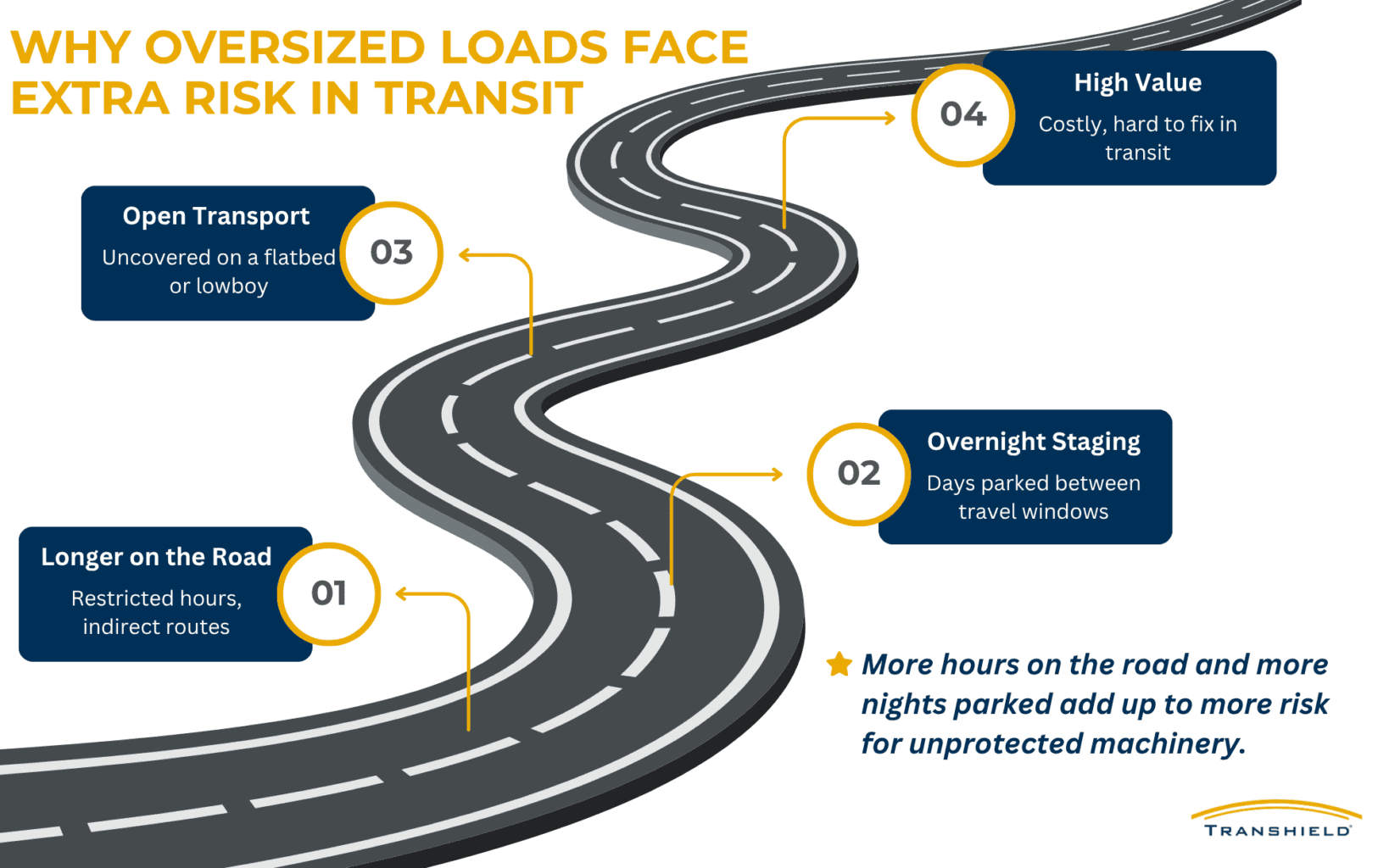
The permits and escorts get the load moving legally. What they do not do is protect the equipment itself, and oversized loads face more exposure than ordinary freight for a few reasons.
- Longer time on the road: Restricted hours and indirect routes stretch the trip out, leaving equipment exposed to weather for longer.
- Overnight staging: Multi-day hauls often park between travel windows, so the load may sit at a yard or lot overnight or over a weekend.
- Open transport: Most oversized machinery rides uncovered on a flatbed, lowboy, or other semi trailer, fully open to rain, road salt, and debris.
- High value: This is usually expensive, non-divisible equipment, so any damage is costly and hard to address on the road.
Put together, an oversized load spends more time exposed than a typical shipment, which makes protecting the equipment a bigger priority, not a smaller one.
Protecting the Equipment During the Haul
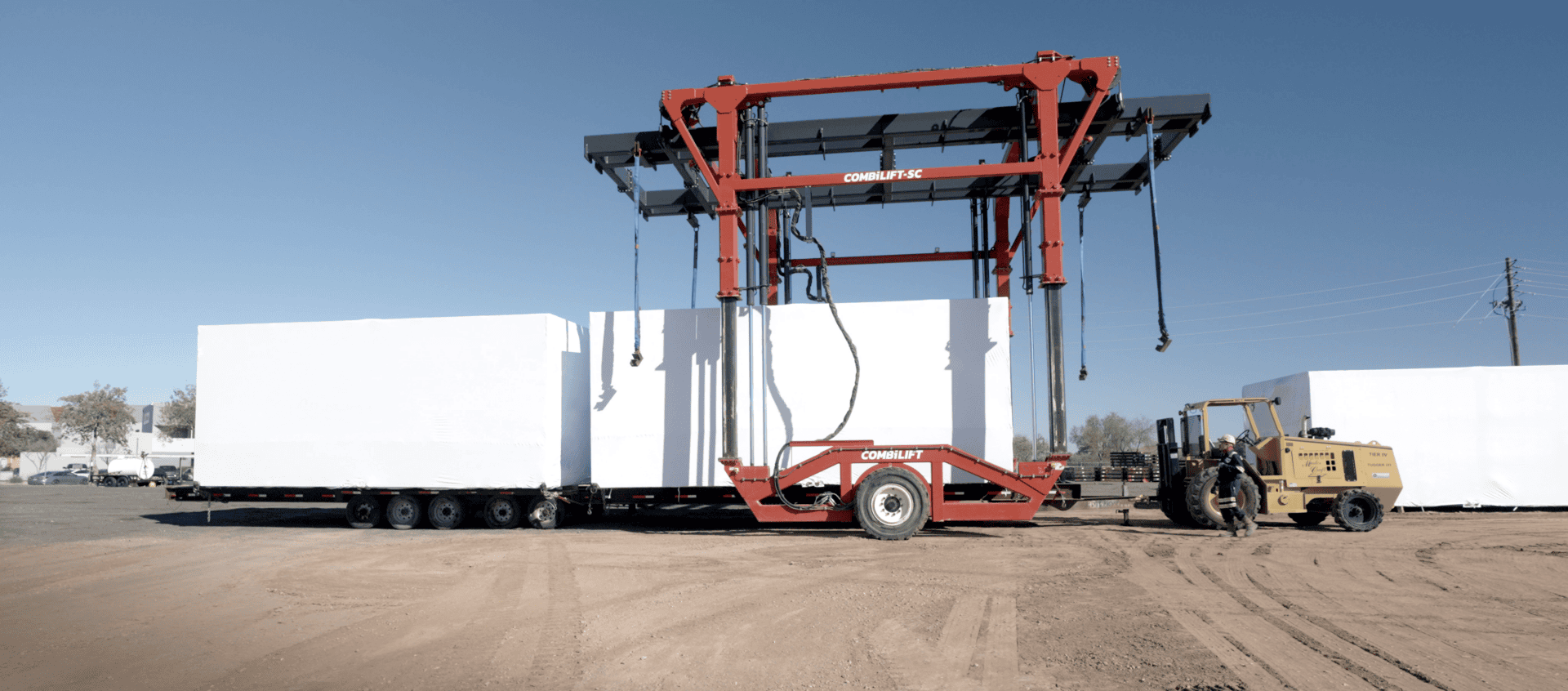
The trailer and tie-downs hold the load in place. A protective cover is what shields the surfaces from everything the trip throws at them. For a high-value piece spending days on an open trailer, the right cover is what keeps it arriving in working condition.
A Cover Built for Days on the Road
This is where a basic tarp falls short. It does not fit the contours of the machine, so it leaves gaps where water and grit get in, and over a long haul, wind and road vibration can shift it out of place. A cover cut for the exact machine you’re hauling fits tightly and stays put for the full trip. Shrinkable fabric draws in to the shape of the equipment, so there is less for the wind to catch, and water runs off instead of pooling against metal.
Slowing Corrosion Over a Long Trip
Time is the real enemy on these moves. Bare metal exposed to road salt and damp air starts to corrode, and a haul measured in days rather than hours gives that process far more time to set in. For any oversized move, a cover containing Vapor Corrosion Inhibitor (VCI) additives earns its place. VCI holds a concentration of protective molecules in the space around the metal, settling into the tight spots and contours that a sprayed coating tends to miss.
| Stage | What Happens |
| Release | VCI molecules vaporize from the source material |
| Migration | These molecules travel through the enclosed space |
| Adhesion | VCI vapors bond with metal surfaces upon contact |
| Protection | A molecular layer forms, blocking moisture and oxygen |
This barrier slows the corrosion process by up to 95% and keeps working for as long as the cover is on, which is exactly what a multi-day, multi-stop haul calls for.
Keep It Covered Until the Machine Is Needed
A delivered load is not always one that goes straight to work. If the equipment will sit in a yard or on site before it is installed, there is no reason to strip the cover off early. Leaving it in place carries the same protection through the wait, so the machine is in the same condition on day thirty as it was the day it rolled off the trailer.
Get the Machine Ready Before Pickup
The hours before loading set up everything that follows. A few steps make the difference on a long haul:
- Wash it down: Grease and caked-on dirt hold moisture against metal and can hide damage you would want on record.
- Photograph everything: For a high-value, non-divisible piece, a clear before-shipping record is what backs an insurance or warranty claim if anything goes wrong.
- Lock down the loose parts: Booms, doors, panels, and attachments should be lowered, pinned, or removed so nothing works free at speed or shifts during an escorted stop.
- Settle the fluids: Handle any leaks and follow the manufacturer’s transport guidance.
- Fit the cover last: Put the protective cover on before the machine leaves the yard, so it is shielded from the first mile.
How Transhield Fits Into Your Shipment
For more than 30 years, Transhield has engineered protective covers for industrial, manufacturing, and commercial operations across the United States. Each one is built on a three-layer system with a patented adhesive that emits VCIs:
- Outer layer: A UV-resistant polyethylene film that turns away sun and water.
- Middle layer: A solvent-free hot-melt adhesive that carries the VCI chemistry working to slow corrosion.
- Inner layer: A soft, non-woven face that draws moisture off the metal and protects finished surfaces from scratching.
Because every cover is cut to size, there is little room for moisture, dust, or debris to find its way in. On an oversized load carrying high-value equipment, that exact fit is what keeps it protected from pickup to delivery.
An oversized move ties up permits, escorts, schedules, and a serious amount of money. The cover is the part that makes sure the equipment shows up ready to run. Backed by ISO 9001:2015 certification and a 97.4% customer retention rate, Transhield can help you ship with confidence.
Ready to protect your next oversized load? Contact Transhield to talk through a custom cover built for your equipment.