
Metal and moisture don’t mix well. When condensation forms on metal surfaces, it sets off a chain reaction that can quietly damage machinery, void warranties, and drive up repair costs. For operations storing or transporting heavy equipment, understanding why condensation happens and how to prevent it can make a real difference in how long your assets last.
What Is Condensation?
Condensation occurs when warm, moist air comes into contact with a cold surface. When the outside temperature drops below the dew point of the surrounding air, water vapor converts to liquid water droplets on contact.
Why Metal Is Especially Vulnerable
Heat transfer is the core issue. Metal conducts temperature changes quickly: it cools down (and heats up) faster than the ambient air around it. That rapid shift is what creates the conditions for condensation to form.
It happens to equipment sitting overnight, moving through different climate zones on a flatbed, or transitioning from a warm indoor facility to cold outdoor air. The metal surface cools, the dew point is crossed, and moisture appears.
Condensation vs. Humidity: Understanding the Difference
These concepts are closely related, but they describe different things. Understanding the distinction matters for equipment protection.
- Humidity refers to the amount of water vapor in the air. Relative humidity is expressed as a percentage of how much moisture the air holds compared to the maximum it can hold at that temperature.
- Condensation is what happens when that humidity converts from vapor to liquid on a surface. It occurs when a surface temperature falls below the dew point of the surrounding air.
This distinction matters for equipment storage because the goal isn’t just to reduce indoor humidity levels — it’s to prevent metal surface temperatures from dropping below the dew point. Both factors need to be managed.
When Condensation Becomes a Problem
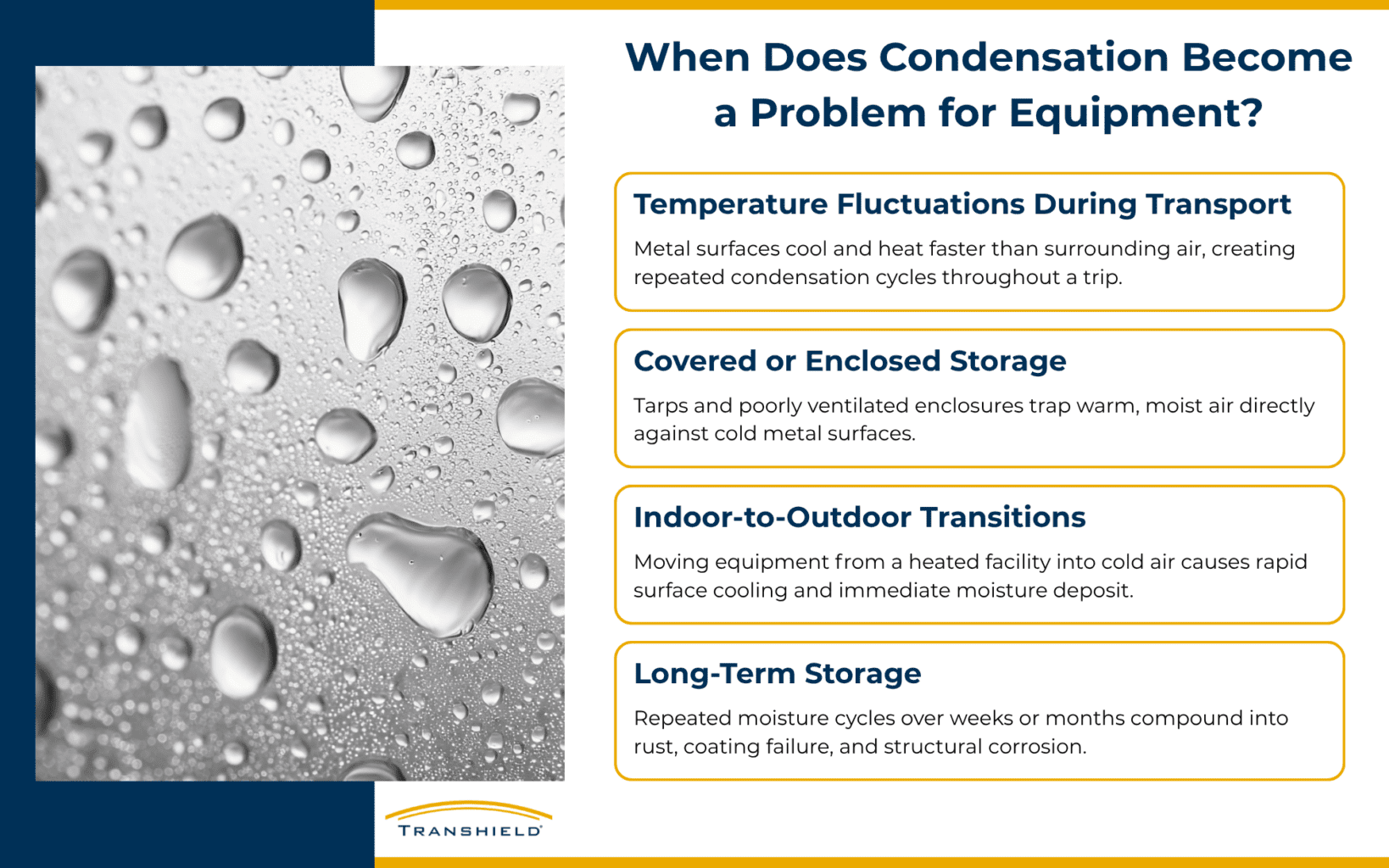
Not every drop of condensation causes immediate damage. The threat grows when moisture accumulates repeatedly or stays in contact with metal for extended periods.
Here’s when it becomes a genuine concern for equipment storage and transit:
Temperature Fluctuations During Transport
When equipment moves through different regions or climates, the metal surface temperature changes while humidity in the surrounding space adjusts more slowly. This mismatch creates condensation cycles that repeat throughout the trip.
Covered or Enclosed Storage
Equipment stored under generic tarps, plain shrink film wrap, or in enclosed spaces with poor ventilation traps warm, moist air. As temperatures drop overnight, that trapped moisture-laden air hits cold metal surfaces and condenses. Excess moisture with nowhere to go accelerates the damage significantly. This is one of the main reasons regular tarps often cause more problems than they solve. Condensation may occur on the film surface as well. Plain shrink film; may have a layer of condensed water droplets that eventually “rain” on the equipment being covered, accelerating the corrosion rates.
The same condensation issue applies inside metal buildings and metal sheds. Even in a covered structure, warm air near the roof deck cools against the cold metal panels, and the resulting condensation can drip directly onto stored equipment below.
Transitions Between Indoor and Outdoor Environments
Moving equipment from a climate-controlled facility into cold outdoor air causes rapid surface cooling. Warm indoor air clinging to the equipment quickly drops below the dew point, depositing water droplets across metal surfaces.
Long-Term Storage
The longer equipment sits, the more condensation cycles it accumulates. Even small amounts of moisture exposure, repeated over weeks or months, add up quickly. Moisture problems that start small (a little surface rust, minor staining, etc.) compound into coating failure and structural corrosion if left unaddressed.
What Condensation Does to Metal
| Effect | What’s Happening |
| Surface rust | Moisture and oxygen react with iron and steel, forming iron oxide |
| Pitting corrosion | Localized moisture buildup breaks down protective surface layers, creating pits that deepen over time |
| Galvanic corrosion | Condensation acts as an electrolyte between dissimilar metals, accelerating corrosion at contact points |
| Staining and discoloration | Mineral deposits from evaporated water leave permanent marks on finished surfaces |
| Paint and coating damage | Moisture under a coating causes blistering, peeling, and adhesion failure |
| Electrical damage | Water on connectors, terminals, and wiring causes shorts and component failure |
Surface rust is usually the most visible result, but it’s often just the indicator of deeper damage happening underneath. By the time you see significant rust on a metal surface, the corrosion process has typically been underway for some time.
How to Prevent Condensation on Metal Equipment
There’s no single solution that addresses every scenario, but a layered approach to moisture management handles most situations effectively.
Control the Environment Where Possible
For equipment stored in a fixed location, environmental controls are the most direct approach:
- Climate-controlled storage keeps temperature and humidity stable, reducing the chance of surfaces cooling below the dew point
- Dehumidifiers lower indoor humidity levels so there’s less water vapor available to condense
- Adequate ventilation allows excess moisture to escape instead of building up against metal surfaces
- Proper insulation in walls and on the roof deck helps keep interior surface temperatures from dropping too quickly during cold periods, reducing the temperature gap that drives condensation
- A vapor barrier on walls or floors prevents ground moisture from migrating into the storage space and raising humidity levels
Without adequate airflow to manage humidity levels, even a well-sealed facility can develop a persistent condensation problem.
These controls work well indoors but aren’t practical for outdoor storage or equipment in transit where environmental factors aren’t predictable.
Use Moisture-Wicking Cover Materials
Generic tarps or regular packaging film create a sealed, stagnant environment where trapped humid air has nowhere to go. When temperatures drop, condensation collects directly against the metal surface and stays there.
Covers with moisture-wicking interior layers pull water vapor away from the metal surface and allow it to escape through the cover material in vapor form. This prevents the cycle of condensation buildup that damages metal over time. In the long run, the difference between a cover that traps moisture and one that actively manages it shows up in equipment condition, warranty claims, and maintenance costs.
Add a Condensation Barrier
A condensation barrier is a material layer that prevents direct contact between moisture and a metal surface. In cover applications, this is typically a soft, non-woven interior layer that physically separates the surface from any moisture that forms.
This is different from simply waterproofing the outside of a cover:
- A water-resistant exterior keeps rain and snow out
- A proper interior barrier addresses the condensation that forms from within, due to temperature and humidity dynamics inside the cover
Consider VCI Technology for Metal Protection
When condensation reaches a metal surface, corrosion depends on how long that moisture stays in contact and whether anything is slowing the electrochemical process down.
Vapor corrosion inhibitors (VCIs) work by releasing protective molecules into the enclosed space surrounding metal. These molecules travel through the space and adhere to metal surfaces, forming an invisible molecular layer that blocks moisture and oxygen from triggering the corrosion reaction.
| Stage | What Happens |
| Release | VCI molecules vaporize from the source material |
| Migration | These molecules travel through the enclosed space |
| Adhesion | VCI vapors bond with metal surfaces upon contact |
| Protection | A molecular layer forms, blocking moisture and oxygen |
For equipment in transit or long-term storage, VCI technology adds a chemical layer of protection that physical barriers alone can’t provide. It’s particularly effective for complex equipment geometries where every surface is difficult to coat or treat directly.
Applying This to Equipment Storage and Transit
The condensation risk doesn’t stay constant. It peaks during specific scenarios:
- Equipment moving from heated facilities to outdoor staging areas
- Long-haul transport through varying climate zones
- Storage inside metal buildings or under metal roofing where the roof deck conducts outside cold temperatures inward
- Off-season storage in uninsulated warehouses or outdoor yards
- Any situation where equipment is wrapped or covered with material that traps humidity
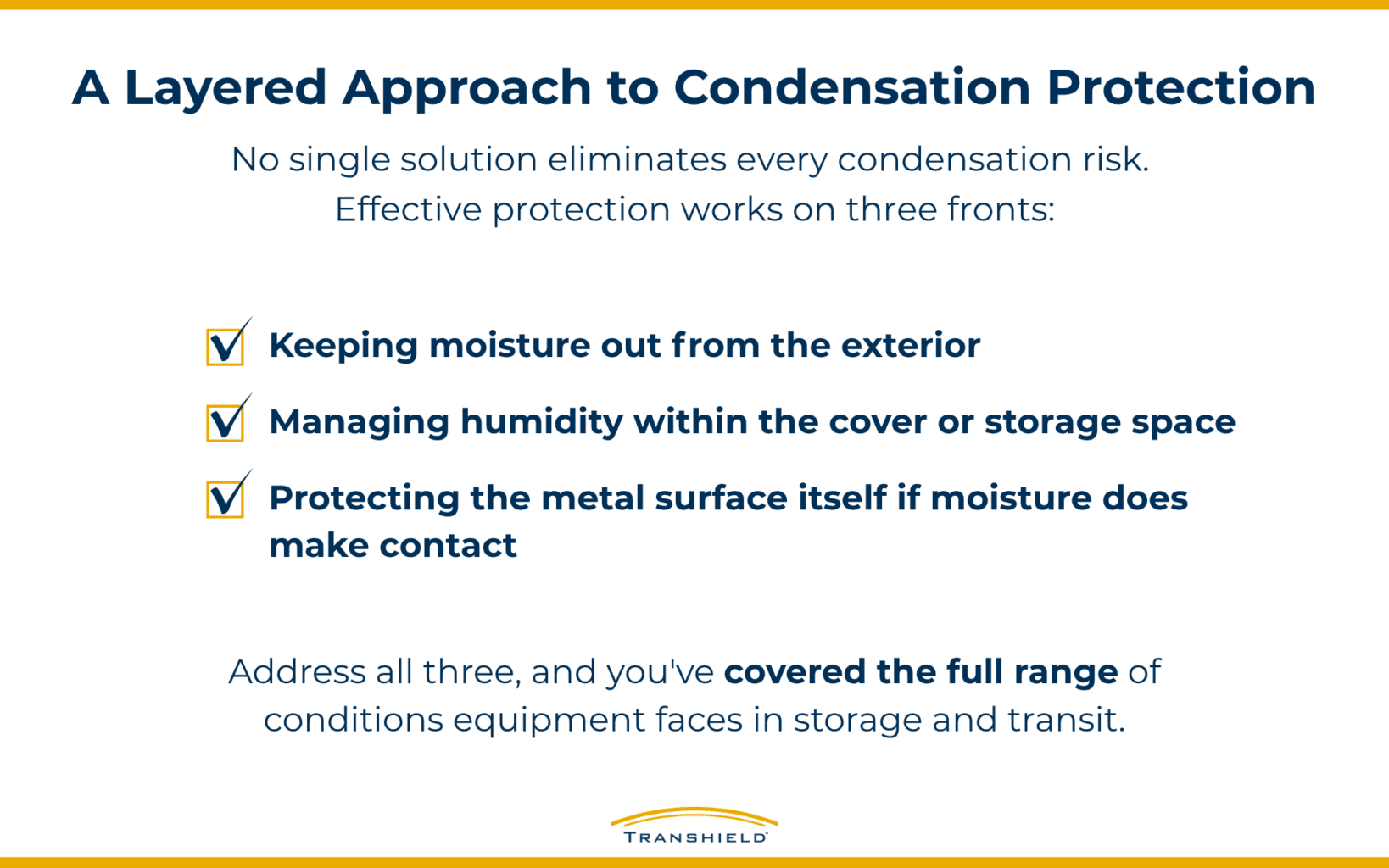
A practical protection approach addresses all three factors:
- Keeping moisture out from the exterior
- Managing humidity within the cover or storage space
- Protecting the metal surface itself if moisture does make contact
How Transhield Covers Address Condensation
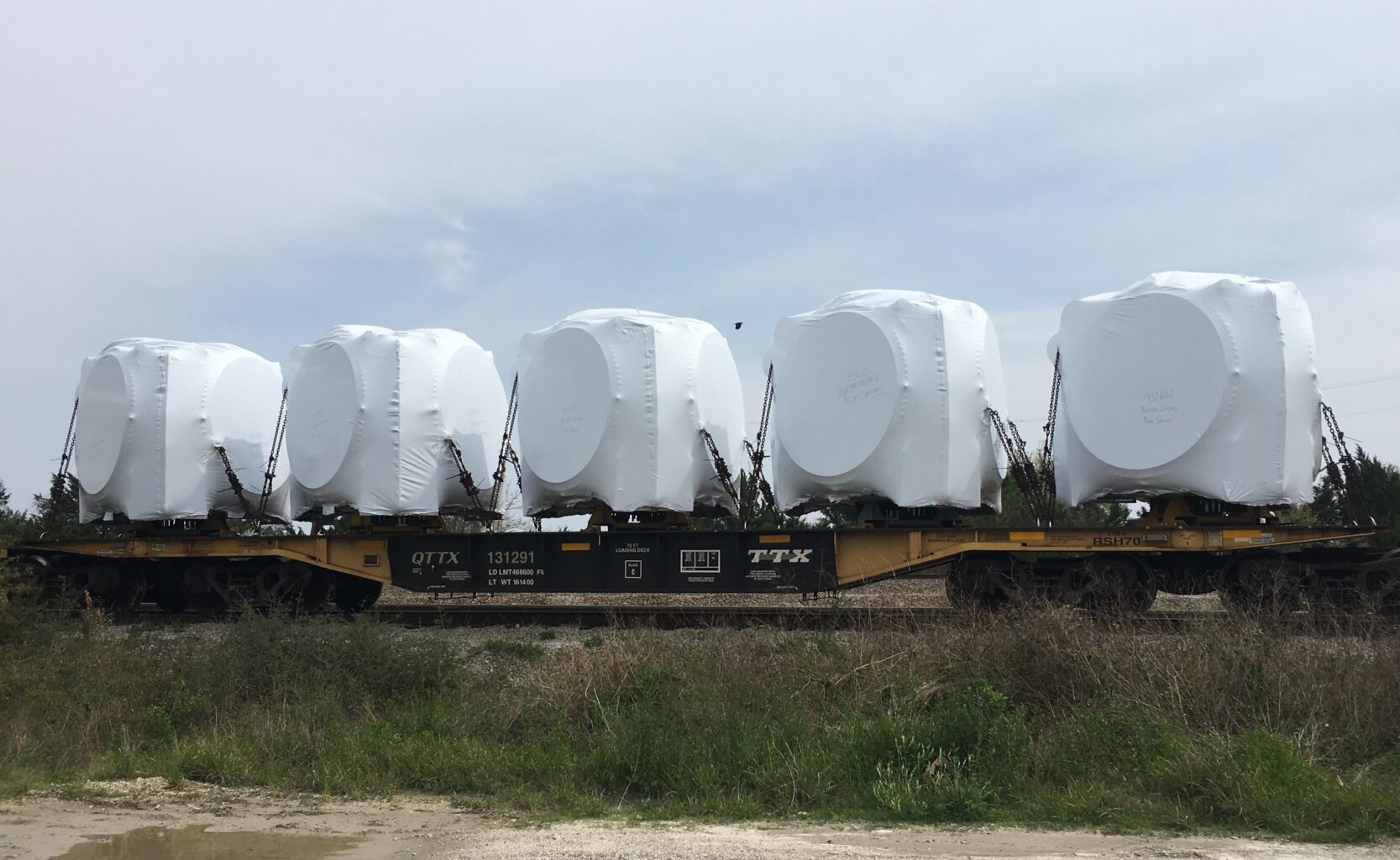
Transhield’s custom protective covers are built around a three-layer system that handles each part of this problem.
- Outer layer: A UV-resistant polyethylene film that blocks water intrusion from rain, snow, and road spray
- Middle layer: A hot-melt adhesive that can include VCI chemistry, delivering corrosion-inhibiting molecules into the enclosed space around your equipment
- Inner layer: A soft, non-woven material that wicks moisture away from metal surfaces and acts as a condensation barrier
This system has shown to reduce corrosion by up to 95% in testing. Covers are custom-designed for specific equipment, which means minimal gaps where humid air can concentrate and areas where pooling occurs. Optional features like vents support airflow management for extended storage situations.
For operations storing or shipping equipment through environments where condensation is a recurring challenge, a well-designed cover does the work of multiple individual solutions in one package.
Protect Your Equipment Before Condensation Costs You
Condensation doesn’t need much time to cause damage on metal, just the right conditions and repeated exposure. The longer equipment sits through moisture cycles, the more those small impacts turn into corrosion, coating failure, and costly warranty repairs.
If you’re storing or transporting high-value assets, protection isn’t just about coverage; it’s about controlling the environment around your equipment and preventing damage before it reaches your customer.
Talk to the team at Transhield to find a custom cover solution built specifically for your equipment and operating environment.