
Moving an entire factory is one of the largest projects a manufacturing operation will ever take on. A company relocation might mean expanding into a new plant, consolidating production lines, or shifting operations to a different location to improve operational efficiency. Whatever the reason, the equipment has to come off the floor, travel to the new facility, and go back into service, and that journey is where most of the damage risk lives.
This guide walks through how to keep your equipment protected at every stage of a factory relocation, from loading and transport to the wait before installation, so each asset reaches the new line in the same condition it left the old plant.
Why Equipment Protection Belongs in Your Relocation Plan
A factory move involves countless moving parts: permits, logistics, scheduling, and the physical transfer of heavy machinery. Equipment protection is one piece that often gets pushed to the end of the list, yet the transport leg is exactly where expensive damage tends to happen.
For manufacturers and distributors, downtime is the real cost. Every day a machine sits damaged or waiting on repair is a day your new plant is not producing. Damaged equipment can also void manufacturer warranties and create gaps in a supply chain that your customers depend on. Building protection into your relocation project from the start is one of the most direct ways to restart your production line on schedule and keep customers supplied through the transition.
Common Risks to Equipment During a Factory Move
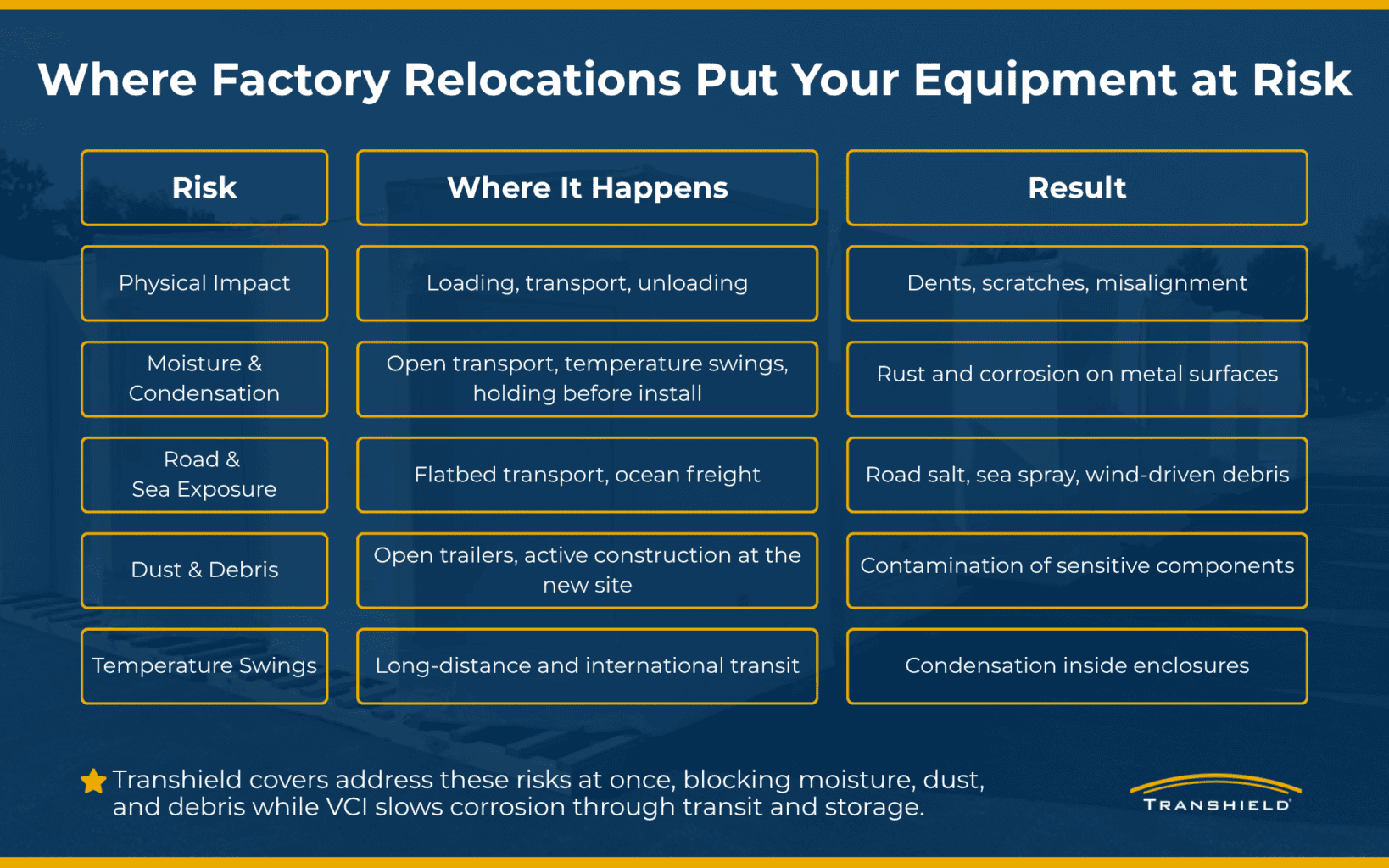
Equipment faces threats the moment it leaves its fixed position on the assembly line. Understanding these potential challenges helps you plan the right protection.
Many of these risks overlap. For example, a machine on an open trailer can face moisture, road debris, and temperature swings all on the same trip.
Build Protection Into Your Planning

Careful strategic planning is what separates a smooth relocation from a chaotic one. Equipment protection works best when it is part of the strategy from day one rather than an afterthought once the trucks arrive.
A few questions to work through early:
- How far is the move? A short local haul is different from an international factory relocation where machinery may spend weeks in transit and port holding.
- Will there be a gap before installation? New lines are rarely ready the moment equipment arrives. Utilities, calibration, and install sequencing can leave machinery waiting, so plan for a holding period.
- What are the regulatory requirements? Some moves involve environmental regulations or permits that affect how and where equipment can be stored.
- Who is managing the move? Many operations bring in an interim manager or work with a factory relocation service provider to coordinate the project management side.
Answering these early lets you match the right protection to each asset before the relocation process begins, which supports a smooth transition with minimal disruption.
Preparing Equipment for the Move
Good prep prevents a lot of corrosion and damage before equipment ever leaves the floor. Taking the time to ready each machine pays off at the new location.
A practical checklist before anything moves:
- Clean every surface. Dirt and grease trap moisture and hide existing wear.
- Document condition. Photograph and log each asset. This record matters if you need to file a warranty claim or prove when damage occurred.
- Drain or secure fluids. Follow manufacturer guidance to prevent leaks in transit.
- Protect exposed metal. Address bare spots before they reach the road.
- Plan the cover. Match each piece of equipment with a protective cover designed for its specific shape and size, and put it on before the equipment leaves the floor.
Protecting Equipment Through Transport and the Hold
Start with the Transport Leg
The move itself puts equipment through the conditions that cause the most damage. On an open or flatbed trailer, machinery meets road salt, wind-driven debris, rain, and rapid temperature changes. A long-distance or international haul stretches that exposure out over days or weeks. Generic tarps leave gaps, trap moisture, and blow loose at highway speed. A cover built for your specific machinery closes those gaps and stays put for the full trip.
One of the biggest hidden threats in transit is corrosion. Metal surfaces exposed to moisture and oxygen start breaking down quickly, and a move puts equipment through the exact conditions that accelerate it.
Why VCI Matters for Relocation
When corrosion is a concern, and during a factory move it almost always is, a cover containing Vapor Corrosion Inhibitor (VCI) additives gives you protection that a plain barrier cannot. VCI works by maintaining a concentration of protective molecules in the space around the metal. Those molecules settle on every surface, including recessed areas a coating could never reach.
How VCI Technology Works
| Stage | What Happens |
| Release | VCI molecules vaporize from the source material |
| Migration | These molecules travel through the enclosed space |
| Adhesion | VCI vapors bond with metal surfaces upon contact |
| Protection | A molecular layer forms, blocking moisture and oxygen |
This vapor delivery slows the corrosion process by up to 95% in testing, and the protection lasts as long as the cover stays in place.
Plan for the Hold Before Installation
Equipment rarely goes straight from the truck into a running line. If the new facility is still being finished or installation is sequenced over several weeks, machinery may have to sit and wait. That holding period is its own corrosion risk, even indoors, because temperature swings still cause condensation under and around equipment.
This is why removing covers the moment equipment arrives is a mistake. Leaving protective covers in place through transit and the hold keeps assets safe until the production line is genuinely ready to receive them. The cover does double duty: it protects on the road and keeps protecting while equipment waits.
Special Considerations for Long-Distance and International Moves
Not every factory move is a simple drive across town. Longer hauls and complex situations bring extra exposure worth planning for.
- International relocation: An international plant relocation adds ocean transit, customs delays, and exposure to sea spray and humidity. Equipment can spend weeks in transit and port holding before it reaches the new location.
- Phased moves: Many operations keep part of the production line running while another section moves, so some equipment travels and waits while the rest keeps working.
- Oversized machinery: Equipment too large to store indoors at either end may be held in a laydown area, where weather protection matters more.
- Warranty integrity: Documenting condition and protecting assets properly helps you avoid disputes if a manufacturer questions a warranty claim after the move.
Matching your protection plan to these factors early prevents headaches later in the relocation project.
How Transhield Helps Protect Your Move
Transhield has spent over 30 years developing the highest quality protective solutions for industrial, manufacturing, and commercial applications. Our custom covers use a three-layer system with a patented adhesive that emits VCIs:
- Outer layer: A UV-resistant polyethylene film that blocks sunlight and repels water.
- Middle layer: A hot-melt adhesive that carries VCI chemistry, releasing molecules that slow corrosion.
- Inner layer: A soft, non-woven material that pulls moisture away from surfaces and guards against scratches.
Each cover is designed for your specific equipment, so there are limited gaps where moisture, dust, or debris can enter. From moving a single machine type to transferring an entire manufacturing plant, the right protection keeps your assets in factory-fresh condition from the old location to the new, on the road and through the wait before startup.
A complete factory relocation is a major project with a lot of pressure to get right. Protecting your equipment should not add to that pressure. With ISO 9001:2015 certification and a 97.4% customer retention rate, Transhield can help you build equipment protection into your relocation plan from the start.
Ready to protect your equipment during your next factory move? Contact Transhield today to discuss custom cover solutions for your relocation.