
Vehicle inventory rarely moves the moment it’s ready. For manufacturers, OEMs, and dealers handling semi-trucks, commercial trucks, trailers, recreational vehicles, and motorhomes, units sit in inventory on storage lots and in holding yards while they wait to be sold, shipped, or assigned. A unit can wait weeks or months before it reaches a buyer, and the whole time it sits, the elements keep working on it. Protecting that inventory is what keeps each one in sellable, factory-fresh condition.
This guide covers fleet storage best practices for keeping vehicle inventory protected from the day it lands on the lot to the day it ships out.
Why Vehicle Inventory Deteriorates in Storage
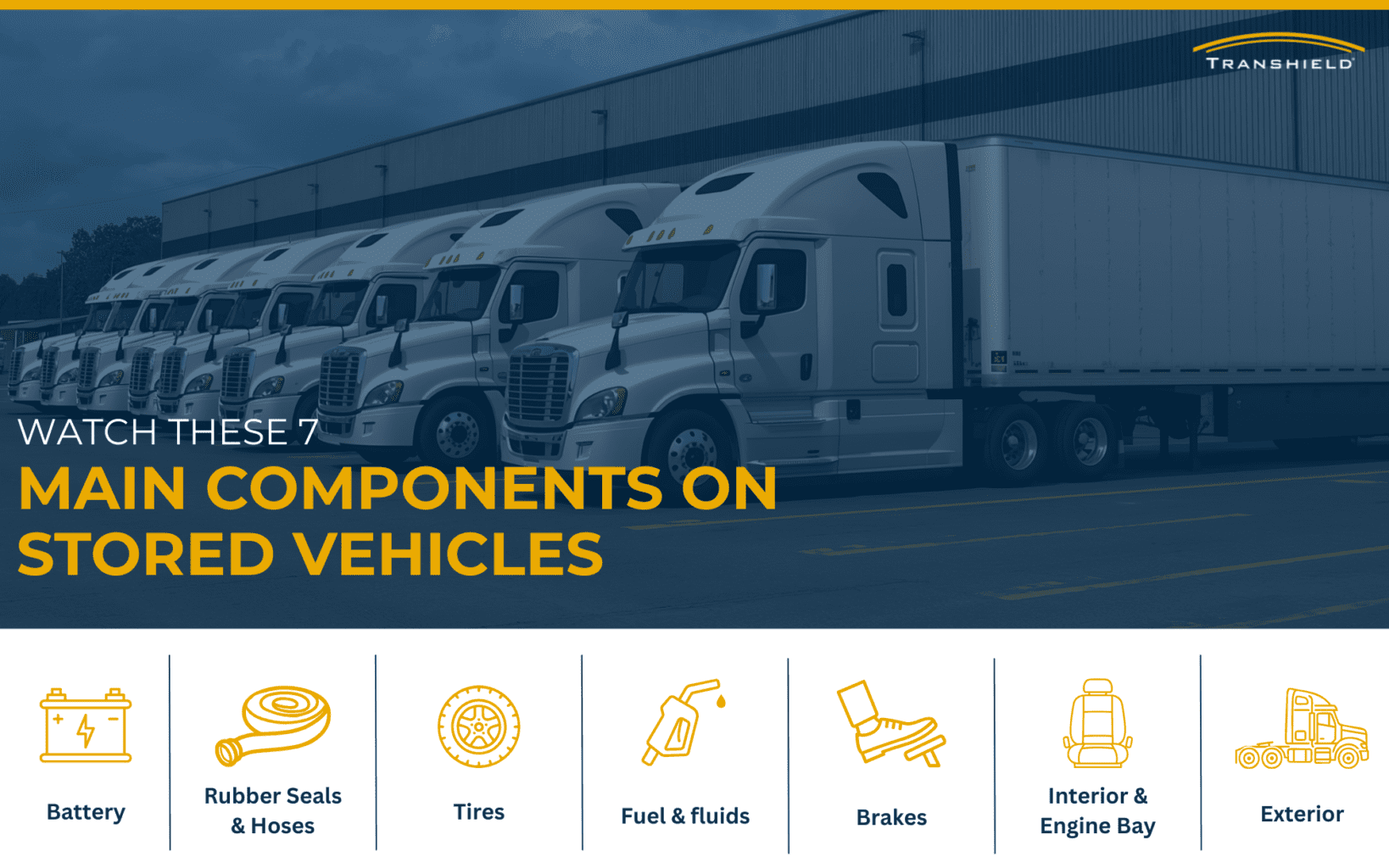
A vehicle sitting in inventory faces a different set of problems than one in daily use. Parked for the long haul, fluids settle, seals dry out, and small issues have time to spread before anyone notices. Here is what storage does to a typical motor vehicle:
| Component | What Happens in Storage |
| Battery | Slowly discharges and can sulfate, leaving it dead at startup |
| Rubber seals and hoses | Dry out and crack without use |
| Tires | Lose pressure and develop flat spots from sitting in one position |
| Fuel and fluids | Fuel degrades, and condensation can form in tanks and lines |
| Brakes | Rotors and components develop surface corrosion |
| Interior and engine bay | Rodents nest and moisture encourages mold and mildew |
| Exterior | UV rays fade paint while dust and contaminants build up |
On a single unit, these are minor fixes. Across a lot full of inventory, they add up to reconditioning and maintenance costs, warranty claims, and vehicles that look tired before they ever reach a buyer. Left unmanaged, poor storage quietly chips away at both margins and operational efficiency.
The good news is that none of this is inevitable. With a few consistent practices, inventory can sit for weeks or months and still come off the lot ready to sell.
Match Your Plan to the Length of Storage
How long a unit will sit determines how much prep it needs. A vehicle staged for delivery next week is a different case than a slow-moving unit or seasonal stock that will hold for months. Sort your inventory by expected storage time, then prep each group to the right level:
- Short-term storage (days to a few weeks): Keep units clean, charged, and covered.
- Long-term storage (a month or more): Everything above, plus fuel stabilizer, tire pressure management, rodent protection, and covers with corrosion control for the metal underneath.
Sorting first keeps your team from wasting prep on quick-turn units, or under-protecting the ones that sit for months.
Build a Repeatable Storage Protocol
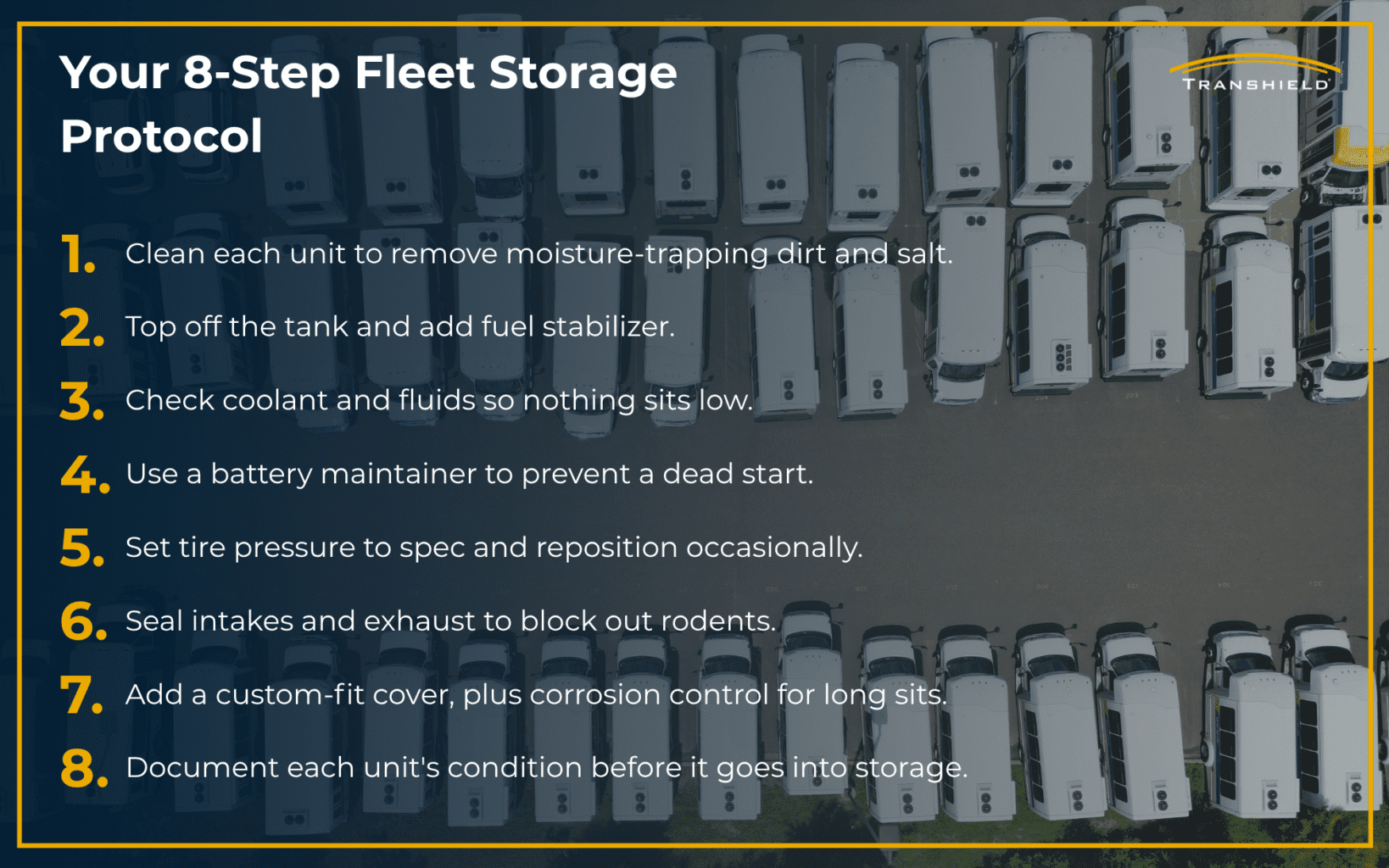
Sorting your inventory tells you what each unit needs. A protocol makes sure that prep actually happens, the same way every time. Across a full lot, consistency is what holds protection together: a written process that every team member follows keeps every unit protected to the same standard, no matter who parks it. A solid protocol covers:
- Clean each vehicle inside and out, since dirt and salt trap moisture against paint and metal.
- Top off the fuel tank, and add stabilizer for long-term storage to limit condensation and fuel breakdown.
- Check engine coolant and other fluids so nothing sits low or contaminated.
- Connect a battery maintainer, or disconnect the battery, to prevent a dead start.
- Set tire pressure to the recommended level, and for long sits, reposition units occasionally to avoid flat spots.
- Seal intakes and exhaust openings against rodents, and place deterrents in the cab and engine bay.
- Cover each unit with a custom-fit cover, adding corrosion control for units that will sit long-term.
- Document each vehicle’s condition with photos and notes before it goes into storage.
That last step matters at scale. A simple log of what went into storage, when, and in what condition gives you a baseline for warranty questions and a clear view of your inventory.
Protect the Exterior on the Lot
Most vehicle inventory is stored outdoors. An indoor vehicle storage facility might seem like the perfect solution, since it shields units from sun, rain, and snow entirely. But renting enough vehicle storage space from a third-party service provider to hold a full lot of semi-trucks, commercial trucks, or motorhomes gets expensive fast, and few operations have that much covered square footage on site. For most fleets, an outdoor storage lot does the work, which makes exterior protection the deciding factor in what condition a unit is in when a buyer finally sees it.
Why Custom Covers Beat Tarps
A generic tarp is not enough. Tarps trap moisture, blow loose in the wind, and leave gaps where water and debris get in. Among storage solutions for outdoor inventory, custom covers solve those problems best. Transhield covers use a three-layer system with patented adhesive that emits VCIs, engineered for long-term storage:
- An outer layer of UV-resistant film that blocks UV rays and repels rain and snow.
- A soft inner layer that wicks moisture away and protects paint from scratching.
- A middle adhesive layer that can carry Vapor Corrosion Inhibitor (VCI) additives to slow corrosion on metal surfaces.
Because each cover is built to fit a specific vehicle, there are limited gaps for moisture, dust, or pests. For metal components, VCI works by maintaining a concentration of protective molecules in the space around the metal, forming a barrier that slows corrosion for as long as the cover stays in place. Covers containing VCI additives can reduce corrosion by up to 95%, which keeps inventory closer to factory-fresh condition through long storage.
Keep Inventory Sale- and Delivery-Ready
Storage is only half the job. The other half is moving units off the lot quickly and in top condition when they sell or ship. That last stretch matters as much as the lot: a unit hauled on an open carrier faces road debris, salt spray, and weather the whole way, so the protection that guarded it in storage should travel with it. Reconditioning a neglected unit cuts into margin and can drag down its sale price.
A few habits keep stored inventory ready to move:
- Inspect on a schedule: Walk the storage lot regularly, keeping access lanes clear, to catch shifted covers, low tires, or pooling water before they turn into problems.
- Keep records current: Update your log with each inspection so you know the status of every unit at a glance.
- Prep before it ships: Before a vehicle leaves the lot, check fluids, charge or reconnect the battery, confirm tire pressure, and remove rodent deterrents.
- Stagger the work: Bringing a large block of inventory back to ready condition all at once strains your team, so sequence it by what sells or ships first.
- Protect units in transit: For vehicles hauled on open trailers, keep the cover on through the move so road debris, salt, and weather don’t undo months of careful storage.
Vehicles that were stored well move faster, need less reconditioning, and hold their value for the next vehicle owner.
Protect Your Vehicle Inventory

Inventory sitting in storage is unavoidable, but deterioration is not. With a plan matched to the length of storage, a repeatable protocol, and the right exterior protection, you can hold vehicles with confidence and deliver them in the condition buyers expect.
Transhield has spent over 30 years helping manufacturers, OEMs, and dealers across the United States protect vehicles and equipment during storage and transport. Our custom covers are designed to fit your exact units and built to handle the elements from every direction, so your inventory stays protected from the lot to delivery.
Ready to protect your fleet vehicles? Contact Transhield today to talk through custom cover solutions for your needs.