
Volatile corrosion inhibitors are one of the most effective tools available for protecting metal equipment from rust and corrosion during storage and transit. But not every VCI product performs the same way, and the conditions surrounding your equipment play a major role in how well the technology works. Understanding the factors that influence VCI performance helps you make better decisions about rust protection, avoid costly corrosion damage, and get the most value from your investment.
A Quick Refresher: How Vapor Corrosion Inhibitors Work
VCI stands for vapor corrosion inhibitor, though you may also see the term volatile corrosion inhibitor used interchangeably. Either way, the technology works the same:
- VCI molecules vaporize from a source material and travel through the space surrounding your equipment.
- When these molecules reach a metal surface, they bond to it and form a thin protective barrier that blocks moisture, oxygen, and other corrosive elements from making contact.
Unlike a spray or paint coating that requires direct application, VCI vapors migrate through the enclosed space to reach every exposed surface on their own.
| Stage | What Happens |
| Release | VCI molecules vaporize from the source material |
| Migration | These molecules travel through the enclosed space |
| Adhesion | VCI vapors bond with metal surfaces upon contact |
| Protection | A molecular protective barrier forms, blocking moisture and oxygen |
That process sounds straightforward, but several real-world factors determine whether the VCI delivers full corrosion prevention or falls short.
Key Factors That Affect VCI Performance
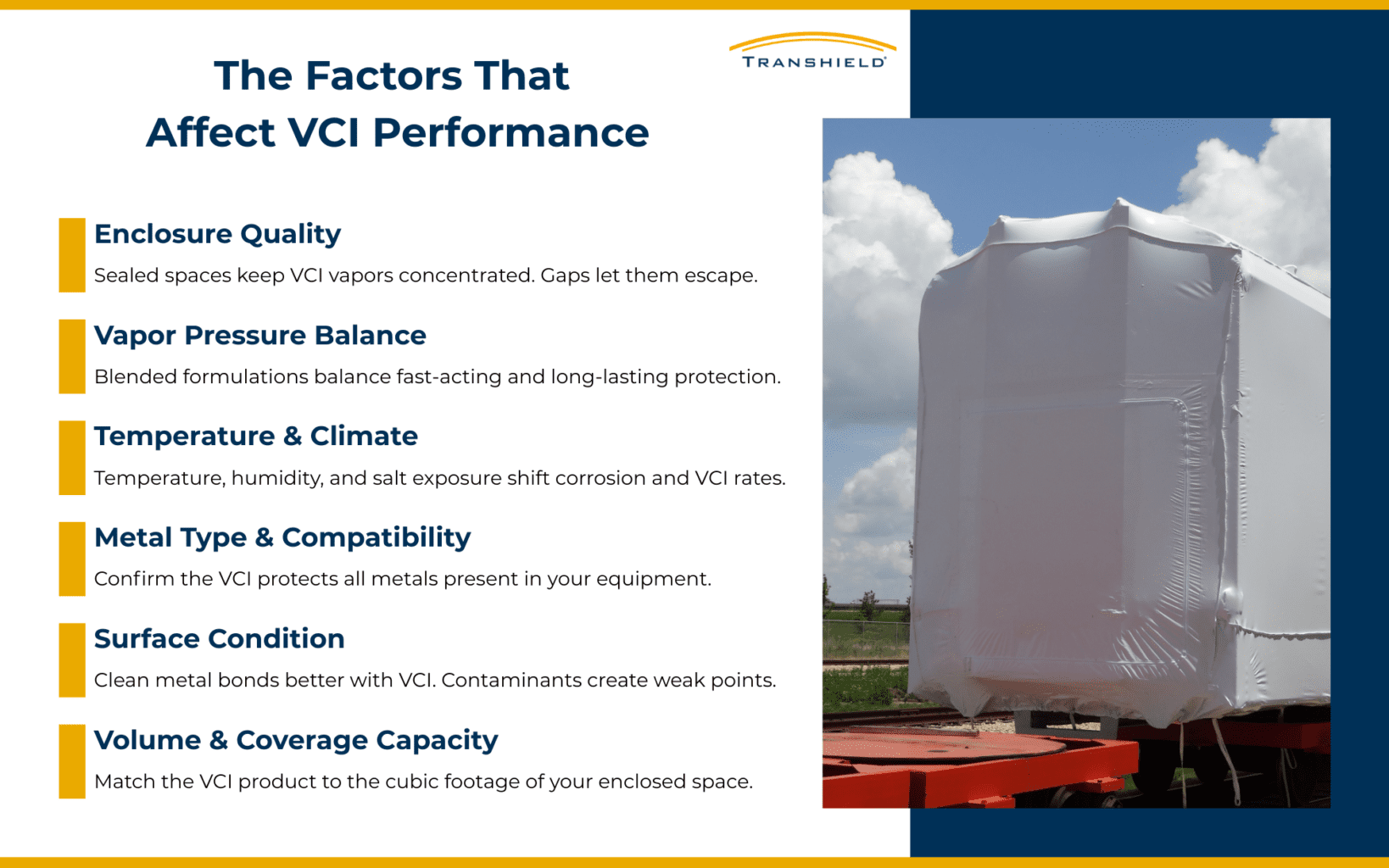
Enclosure Quality
This is the single biggest factor in VCI effectiveness. Vapor corrosion inhibitors work by maintaining a concentration of protective molecules in the space around the metal. If that space has gaps, tears, or poor seals, the VCI vapors escape, and the concentration drops below protective levels.
The more enclosed the environment, the better the protection. A well-sealed enclosure keeps VCI molecules where they need to be: surrounding the equipment.
Vapor Pressure Balance
Not all VCI formulations are created equal. The vapor pressure of a VCI compound determines how quickly it vaporizes and how long it lasts.
- Too low: The rust inhibitor takes too long to reach effective concentrations, leaving metal exposed during the critical early period.
- Too high: The VCI depletes quickly, which limits how long it can maintain protection.
Quality VCI compounds blend multiple formulations to provide protection over the short, medium, and long term. This combination means the equipment gets fast initial protection while also maintaining a sustained corrosion barrier for months or even years.
Temperature and Climate Conditions
Temperature has a direct relationship with both corrosion rates and VCI behavior. As temperatures rise, corrosion accelerates. Fortunately, higher temperatures also increase the rate of VCI vaporization, creating a self-correcting effect.
Watch out for these climate-related risks:
- Winter storage and seasonal temperature swings create condensation, adding moisture to the environment around your equipment
- Salt water exposure during coastal transit accelerates corrosion on steel and iron components
- High humidity conditions keep metal surfaces wet longer, giving corrosion more time to take hold
A VCI solution paired with moisture-wicking materials handles these conditions more effectively than VCI alone. The Shrinkable Fabric® by Transhield delivers multi-metal VCI formulation, moisture wicking inner layer, and shrinkable film layer to keep contaminants out, all in one package.
Metal Type and Compatibility
Equipment often contains more than one type of metal. Steel, iron, aluminum, copper, stainless steel, and various alloys can all be present in a single piece of machinery. Older or simpler VCI compounds may only provide corrosion resistance for ferrous metals like steel and cast iron surfaces. This leaves other metal components vulnerable.
Modern VCI products are formulated to protect multiple metals simultaneously. When evaluating a VCI solution, confirm it covers the range of metals present in your equipment, especially if you’re protecting complex machinery with engine parts, wiring, steel reinforcement, and mixed-metal assemblies.
Surface Condition
VCI molecules bond more effectively with clean metal. Dirt, grease, salt, motor oil residue, and other contaminants on the metal surface can interfere with adhesion and create localized areas where corrosion starts earlier.
Cleaning equipment before applying VCI protection is a simple step that significantly improves results:
- Remove loose debris and surface contaminants with a clean cloth and the appropriate solvent or mineral spirits
- On cast iron surfaces or bare steel, remove existing rust with a wire brush before applying protection
- Address any chips in existing paint or primer so the VCI can form a proper bond on exposed metal
Volume and Coverage Capacity
Different VCI products protect different volumes. A VCI film designed for small parts in a box won’t provide adequate coverage for a large piece of heavy equipment in an enclosed space. When selecting a VCI solution, consider the cubic footage of the area you need to protect and make sure the product is rated for that capacity. A product that’s undersized for the job won’t maintain a sufficient concentration of protective molecules within a reasonable time frame.
How VCI Compares to Traditional Corrosion Prevention Methods
People researching corrosion protection often come across a range of rust prevention products. For smaller items, traditional methods can solve the corrosion problem just fine. But understanding where VCI fits relative to these other methods helps clarify why it’s the preferred choice for large-scale equipment protection.
| Method | How It Works | Limitations |
| Protective paint and primer | Creates a physical barrier on the metal surface | Requires direct application; chips and cracks expose bare metal |
| Spray coatings | Applies a protective coating via aerosol | Difficult to reach recessed areas; requires reapplication |
| Paste wax | Creates a thin water-resistant coating on metal | Labor-intensive; requiring removal, not practical for large or complex equipment |
| Multi-Metal VCI technology | Vapor molecules migrate through enclosed spaces to protect all metal surfaces | Requires an enclosed environment to maintain concentration |
Spray-on rust inhibitors, protective paint, and primer work well for direct surface treatment on smaller items. But when you’re protecting large, complex equipment with hard-to-reach areas, internal cavities, and multiple metal types, VCI technology has a clear advantage. The vapor delivery method reaches surfaces that no spray or brush can access, and it does so without requiring disassembly or direct contact.
For operations that store equipment outdoors through winter or ship machinery across long distances, VCI provides continuous protection that doesn’t rely on someone reapplying a coating every few weeks.
Common Mistakes That Reduce VCI Effectiveness
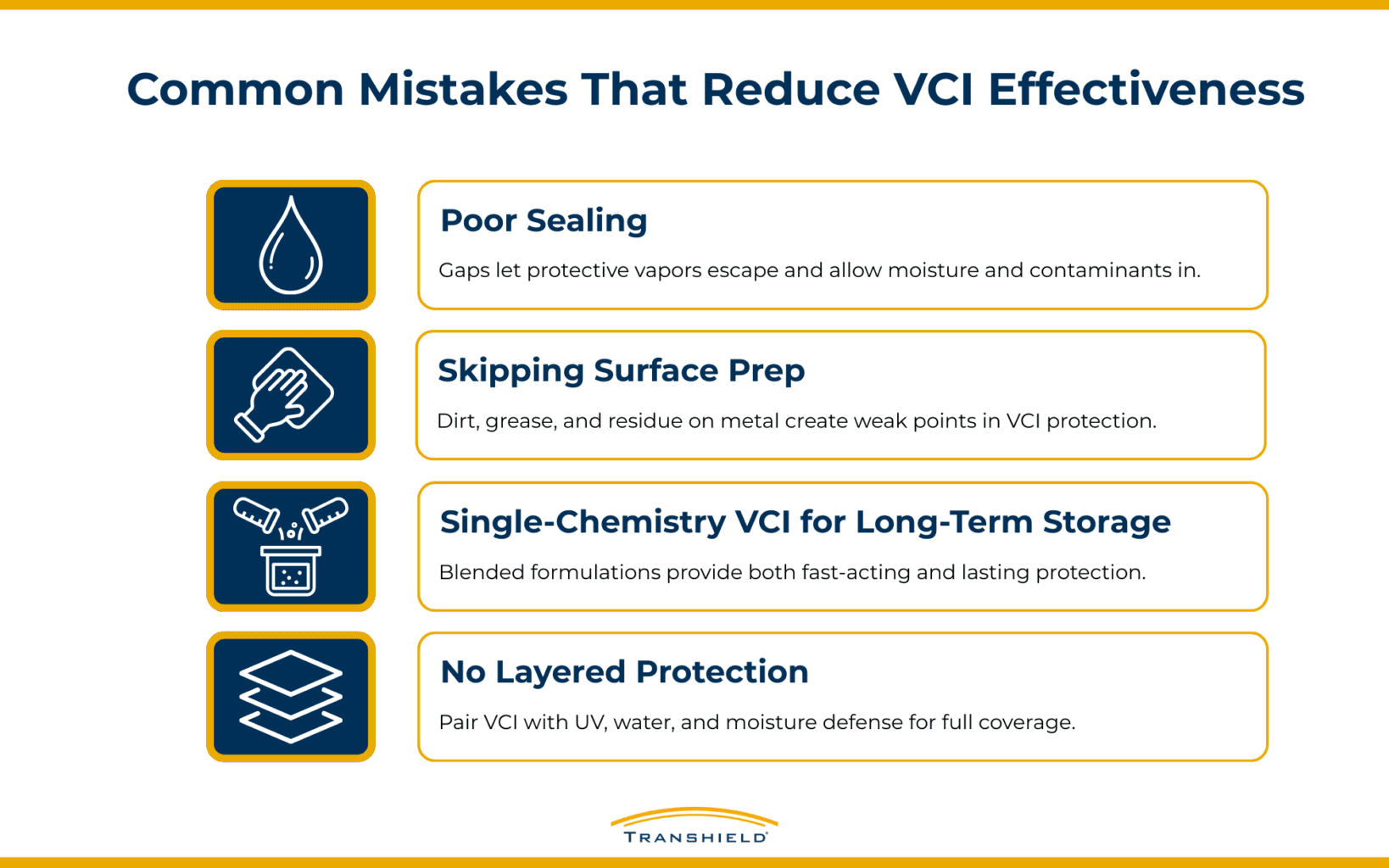
Even good VCI products can underperform if the application doesn’t support them. Watch for these issues:
- Poor sealing around the equipment. Gaps and unsealed openings let protective vapors escape and allow water and contaminants to enter.
- Skipping surface preparation. VCI applied over dirty or contaminated metal surfaces creates weak points in the protective coating.
- Using a single-chemistry VCI for extended storage. Long-term applications need a blended approach that covers both multi-metals and timing: immediate and sustained protection windows.
- Ignoring the rest of the protection equation. VCI works best as part of a complete strategy. Combining it with UV protection, water resistance, and moisture management creates a layered defense against everything from high humidity to saltwater exposure.
VCI Delivery Methods: Matching the Format to the Job
VCI technology can be delivered in several ways, and the right choice depends on what you’re protecting.
| VCI Format | Best For |
| VCI film and bags | Smaller metal parts, components, machine tools |
| VCI paper | Wrapping individual items, lining crates and boxes |
| VCI emitters | Enclosed cabinets, electrical panels, tool storage containers |
| Custom covers containing VCI additives | Large equipment in storage and transit |
For heavy-duty industrial equipment, military assets, and commercial machinery, custom covers containing VCI additives offer the most practical solution. They combine the physical protection of a fitted cover with the chemical protection of vapor corrosion inhibitors, handling multiple threats in a single application.
How Transhield Maximizes VCI Performance
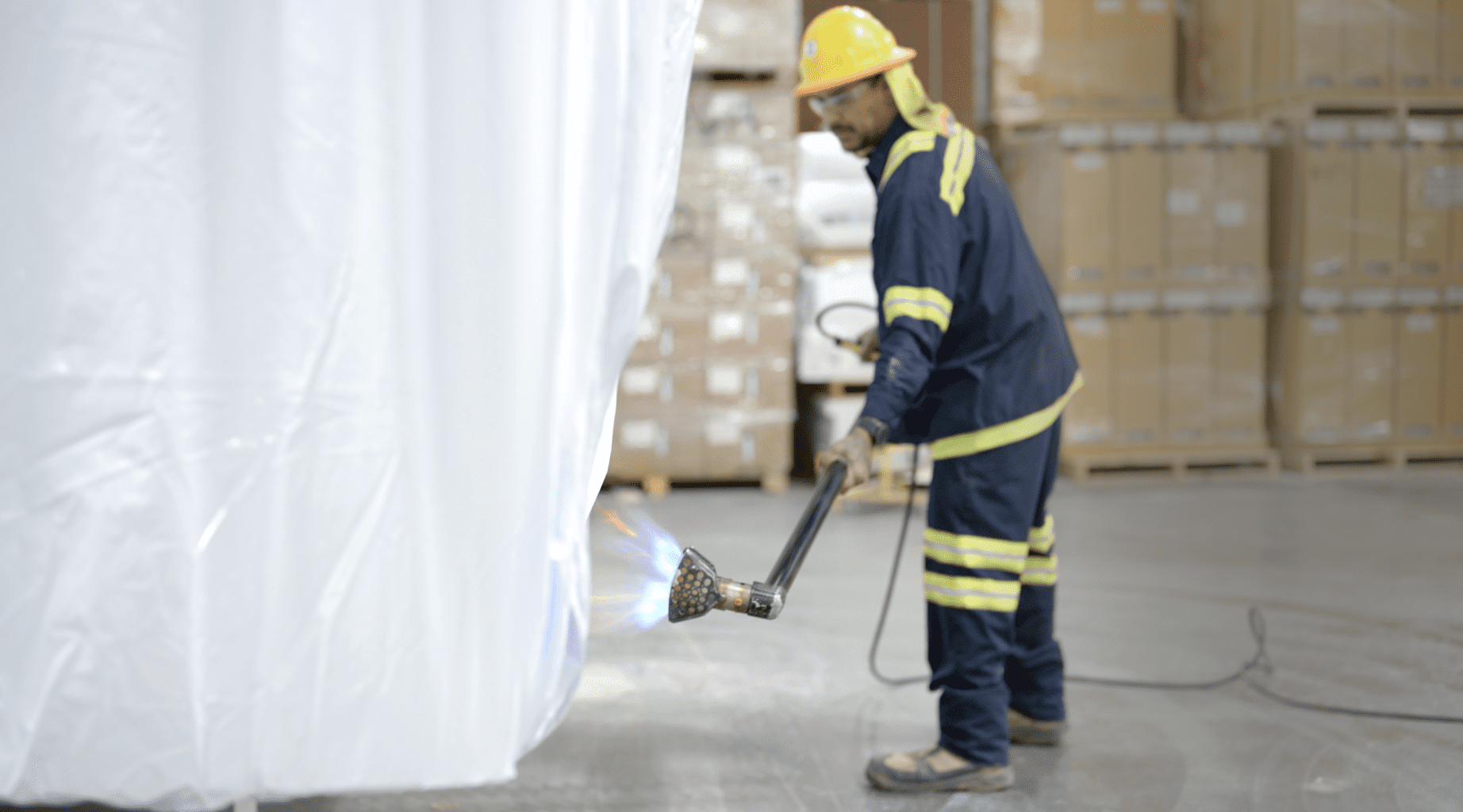
At Transhield, our approach to VCI technology is designed around the performance factors listed above. Our three-layer protective cover system integrates patented adhesive with VCI, creating an efficient delivery method that addresses enclosure, vapor pressure, moisture control, and multi-metal protection all at once.
The Three-Layer System
- Outer layer: Blocks UV rays and repels water
- Middle layer: Patented Hot-melt adhesive containing VCI chemistry that vaporizes into the enclosed space
- Inner layer: Soft, non-woven material that wicks moisture away from equipment surfaces and protects painted surfaces.
The main ingredient in our approach is precision: the right chemistry delivered in the right way.
Why the Custom Fit Matters
As the cover is heat-shrunk to perfectly fit your equipment, the heat from this process activates the adhesive layer and accelerates VCI release. This charges the enclosed space with protective vapors immediately, rather than waiting hours for concentrations to build. The custom fit also eliminates the gaps and loose edges that let VCI escape, maximizing the concentration of protective molecules around your metal components where they matter most.
In testing, this system has reduced corrosion by up to 85-95%, even in high humidity conditions. In typical use conditions, the VCI protection lasts as long as the cover remains in place, making it effective for both short transit windows and extended storage periods.
Getting the Best Results from VCI Protection
Vapor corrosion inhibitors are a proven technology with decades of real-world application behind them. But like any tool, the results depend on how well you use it. To maximize corrosion resistance:
- Match the right VCI product to your specific equipment and metal types
- Maintain a well-sealed enclosure to keep vapor concentrations effective
- Prepare surfaces before application to improve molecular adhesion
- Combine VCI with physical protection layers for comprehensive rust prevention
Transhield has spent over 30 years developing protective solutions that put these principles into practice for industrial, military, and marine applications. If you’re looking for a corrosion protection strategy built around your specific equipment, contact us today to discuss custom cover solutions.