
Concrete curing is a chemical reaction, not a drying process. The hydration process needs moisture and stable temperatures to build compressive strength. Most contractors understand this. But understanding the basics and executing a consistent final curing process on every pour are two different things.
This guide goes beyond the fundamentals. It covers the process variables that experienced contractors deal with on real job sites and in production environments, where weather conditions shift, timelines compress, and the margin for error is slim.
The Chemistry That Drives Everything
A quick refresher on what’s actually happening inside your concrete mix, because the chemistry explains why so many curing problems occur.
How Hydration Works
When water contacts Portland cement, it triggers a hydration process that produces calcium hydroxide and calcium silicate hydrate. These compounds form a crystalline structure that gives concrete its surface durability. The cement particles don’t all react at once. Hydration is gradual, which is why strength development follows a curve rather than a straight line.
Why It Matters for Process Control
Hydration is exothermic. The chemical reaction generates heat, and the rate of that reaction depends on ambient temperature and available moisture.
- Too much heat, too fast: the concrete surface cures unevenly
- Too little moisture: the reaction stalls before the concrete reaches its desired strength
Every decision you make during the curing process either supports or disrupts that reaction.
Where the Curing Process Breaks Down
Most curing failures aren’t caused by a lack of knowledge. They’re caused by process gaps, shortcuts under time pressure, or environmental conditions that change faster than the crew can respond.
Moisture Loss During the Initial Curing Period
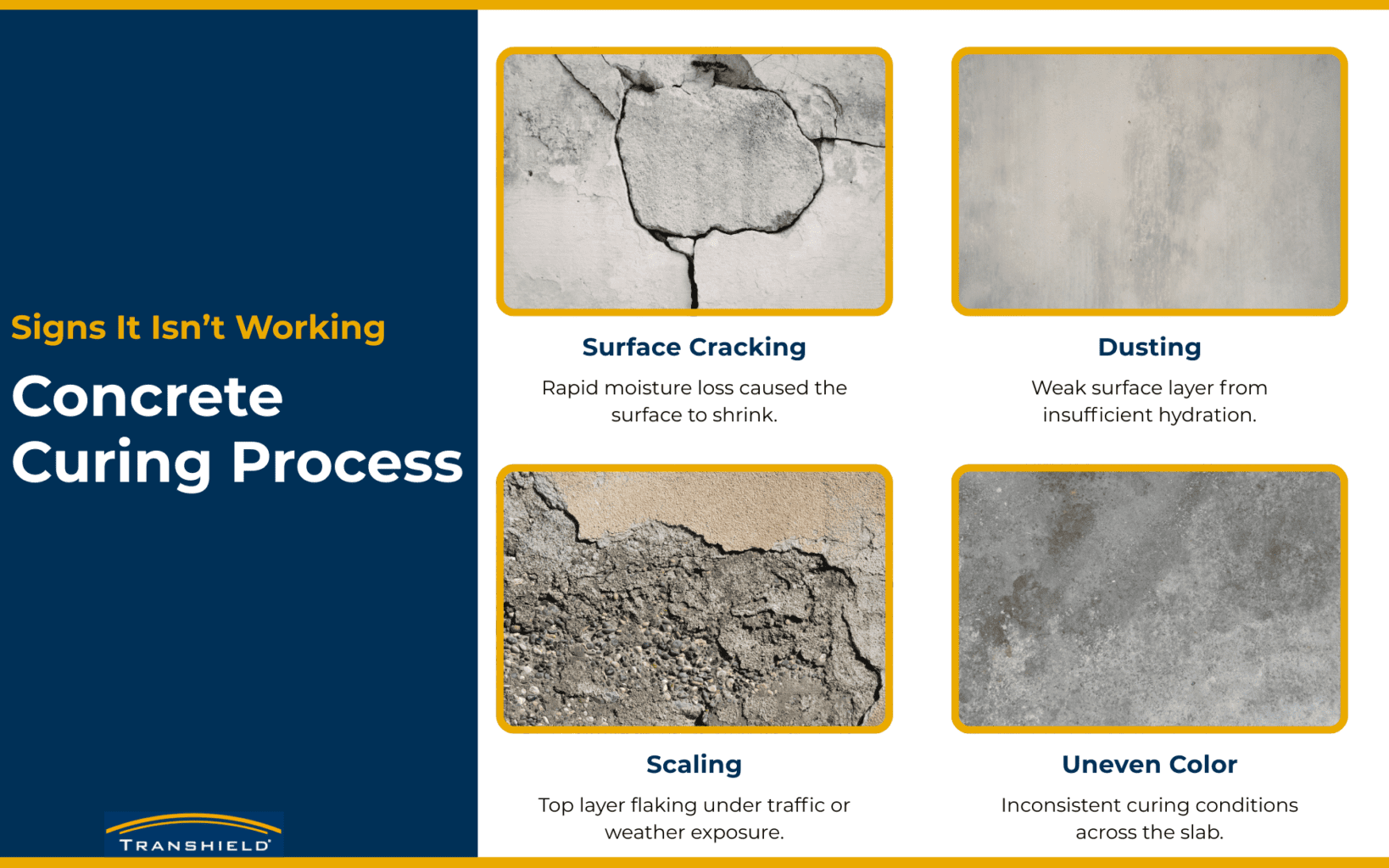
The first 24 hours are the highest-risk window. Fresh concrete is losing moisture to evaporation from the moment it’s placed, and the rate depends on ambient temperature, wind speed, humidity, and direct sun exposure. If the concrete surface dries out during this initial curing period, the hydration process slows or stops in the outer layer while the interior continues to react. The result is a weak surface prone to dusting, scaling, and cracking.
The fix isn’t complicated, but it requires timing. Curing methods need to be applied as soon as finishing is complete, not an hour later when the crew gets around to it.
Temperature Swings
Concrete curing performs best within a narrow temperature window, generally between 50°F and 70°F. The problem is that most job sites don’t offer stable conditions.
| Condition | What Happens | Risk |
| Below 50°F | Hydration slows significantly | Concrete may not reach sufficient strength on schedule |
| Below 32°F | Hydration can stop; water in pores freezes | Permanent strength loss, surface damage |
| Above 85°F | Rapid moisture evaporation, accelerated surface curing | Cracking, reduced abrasion resistance, uneven strength |
| Day-to-night swings | Expansion and contraction cycles in fresh concrete | Surface cracking, internal stress |
Cold weather and hot weather each create different problems, but the common thread is that temperature control during the initial curing period has the biggest impact on final results. Once concrete reaches sufficient durability, it becomes far more tolerant of environmental conditions.
Uneven Curing in Thick Sections
Thicker concrete slabs and structural elements present a challenge that thin pours don’t. The interior of a thick section retains moisture and heat longer than the surface, creating a temperature and moisture gradient. If the surface cures and contracts while the interior is still hydrating, internal stresses build up and can lead to cracking that isn’t visible until weeks later.
For contractors pouring thick foundations, managing this gradient is a key part of the curing process.
Matching Methods to Conditions
There are several methods for maintaining proper moisture and temperature conditions during the curing process. Each comes with trade-offs.
Water Curing
Continuous water application is effective for maintaining moisture levels. Ponding, misting, and soaker hoses all work, but they demand constant attention. If the water supply is interrupted and the concrete surface dries out even briefly, you can create the same cracking problems you’re trying to prevent.
Curing Compounds
A curing compound applied immediately after finishing creates a membrane that slows moisture evaporation from the concrete surface. It’s a practical option when labor or water access is limited. The trade-off is that some compounds interfere with the adhesion of coatings, sealers, or overlays, so they need to be selected and applied with the next step in mind.
Plastic Sheeting
Plastic sheeting is inexpensive and traps moisture effectively. However, it can cause discoloration where it contacts the concrete surface, and it provides no temperature control. In cold weather conditions, plastic alone won’t keep the concrete temperature high enough for proper hydration.
Curing Blankets
Curing blankets, also known as moisture retention covers, minimize moisture loss and temperature rise at the concrete surface, leading to better surface durability and abrasion resistance. They also protect the freshly finished surface from environmental conditions like wind, rain, and UV exposure. Curing blankets are used alongside water applied to the finished surface to supply the moisture the hydration process needs.
For contractors working in variable weather conditions or managing large pours, curing blankets provide consistent results with less ongoing labor than other methods.
Process Consistency Is the Differentiator
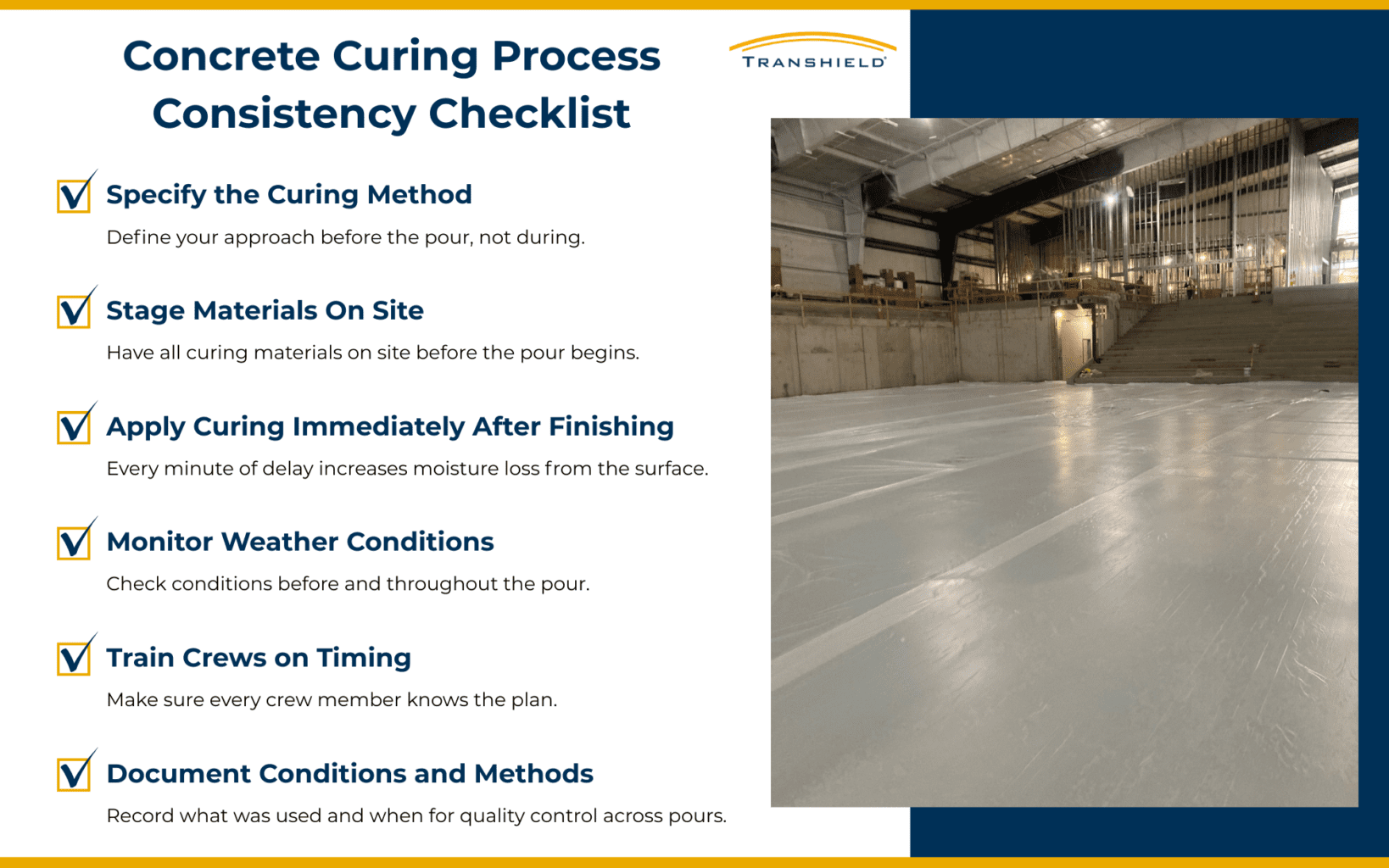
On a construction project, the formwork is built to spec. The finishing crew knows what they’re doing. But if the curing process varies from slab to slab or section to section, the results will too.
The contractors who get the most reliable outcomes treat curing as a defined process, not something left to individual judgment. That means:
- Specifying the curing method in advance
- Having materials on site before the pour
- Training crews on timing
- Monitoring conditions throughout the initial curing period
A consistent process protects your concrete, your timeline, and your reputation.
Protect Your Concrete From Day One
For over 30 years, Transhield has developed protective solutions for industrial applications. Our TopCure Concrete Curing Blankets are designed to minimize moisture loss and protect freshly finished surfaces, helping contractors get consistent results on every pour.
Want to learn how TopCure fits into your final curing process? Contact us today to talk with our team.