
The growing frequency and severity of hailstorms have increased damage to crops, housing, automobiles, aircraft, and industrial goods, including military assets. Hail causes an estimated $10 to 15 billion in damage across the United States every year. For flight operations, fleet managers, and military logistics teams, a single hail event can ground aircraft, sideline vehicles, and trigger repair and inspection costs that far exceed the storm itself.
This blog covers the basics of how hailstorms form, the material damage observed in testing, and how Transhield Hail Protective Covers can help mitigate damage to aircraft and military assets on the ground.
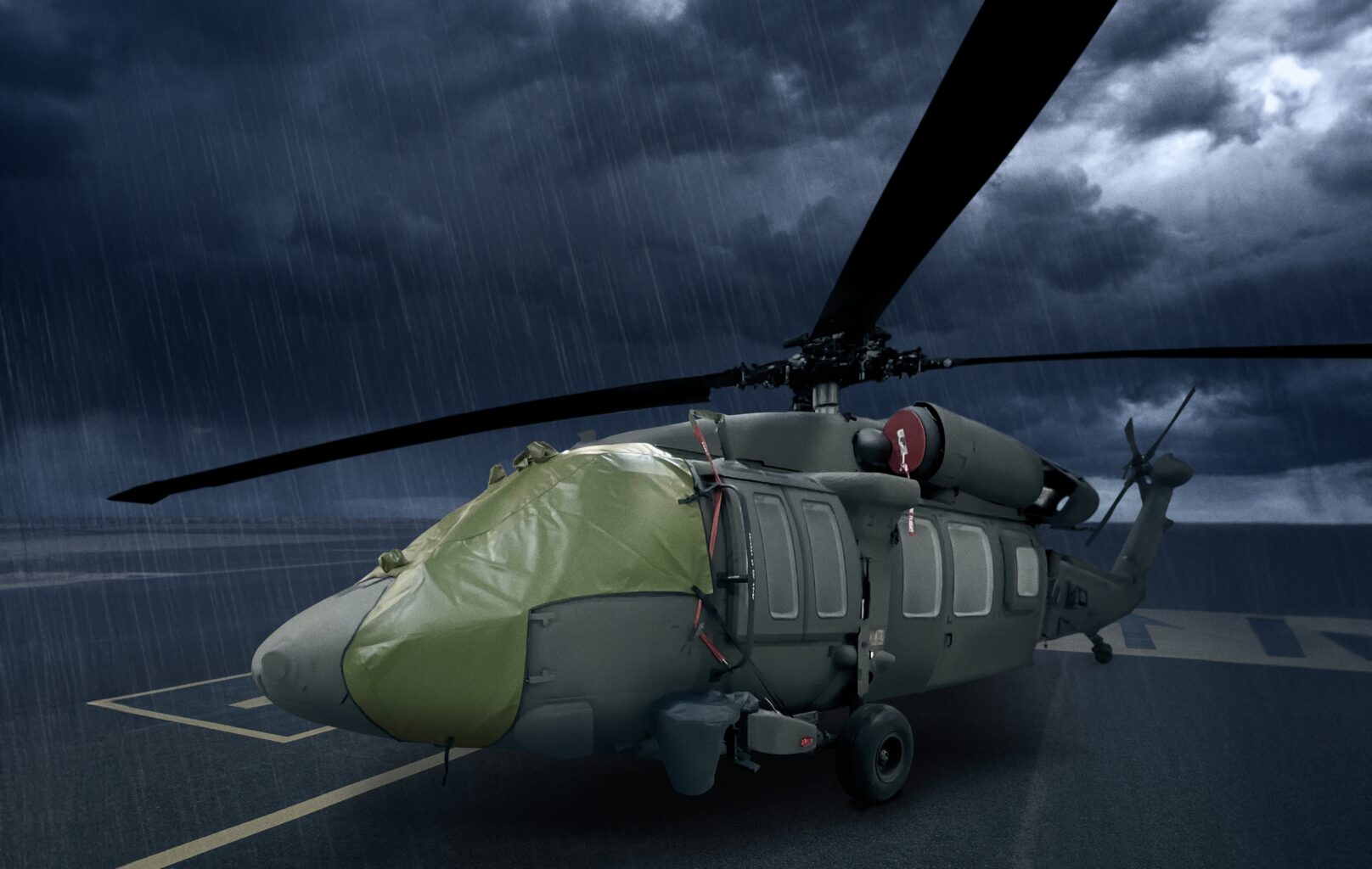
Hail Formation Basics
Hail forms when an updraft during a severe thunderstorm or tornado formation carries water droplets into colder sections of the atmosphere, where they gradually freeze. As more droplets stick together and freeze, the hailstone grows. Smaller hail can be carried away by horizontal winds, but once a stone becomes too heavy for the updraft to push up, it falls. Fall speed climbs with size: a 1-inch hailstone can reach speeds up to 45 mph, and a 2-inch hailstone can reach speeds up to 72 mph. In the U.S., most hail is observed between March and August.
The risk is concentrated but not contained. According to the U.S. Department of Commerce, Storm Prediction Center, National Weather Service, the top five states for hail damage in 2024 were Texas, Kansas, Missouri, Nebraska, and Oklahoma, with a total of 5,373 hail events in a single year. Air bases, airports, and staging yards across the central and southern U.S. sit directly in this corridor, often called hail alley, and hail events still land well outside it.
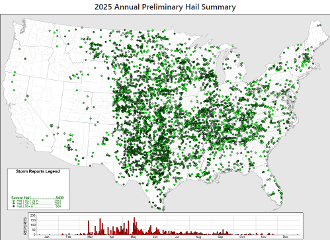
The map below shows the intensity and location of recorded hailstorms in 2025.
Why Parked Aircraft Are Exposed
Most severe hail damage is likely to happen during flight, and pilots are encouraged to use advanced forecasting tools and radar to route around storm cells. On the ground, the options narrow. A parked aircraft is open to extensive damage unless it is parked indoors, and hangar space rarely stretches to cover every airframe on the ramp, let alone support equipment, ground vehicles, and staged assets.
The exposure is the same across personal aviation, commercial fleets, and military installations. Hail rarely arrives alone; the same storm cells bring high winds and heavy rain. Thin aluminum skin panels, control surfaces, lights, and sensors sit face-up to it all, and hail arrives with minutes of warning, not enough time to tow a ramp full of aircraft under a roof. For military operations, the damage carries an extra cost: assets that are dented, cracked, or awaiting inspection are assets that are not mission-ready.
Testing for Hail Damage
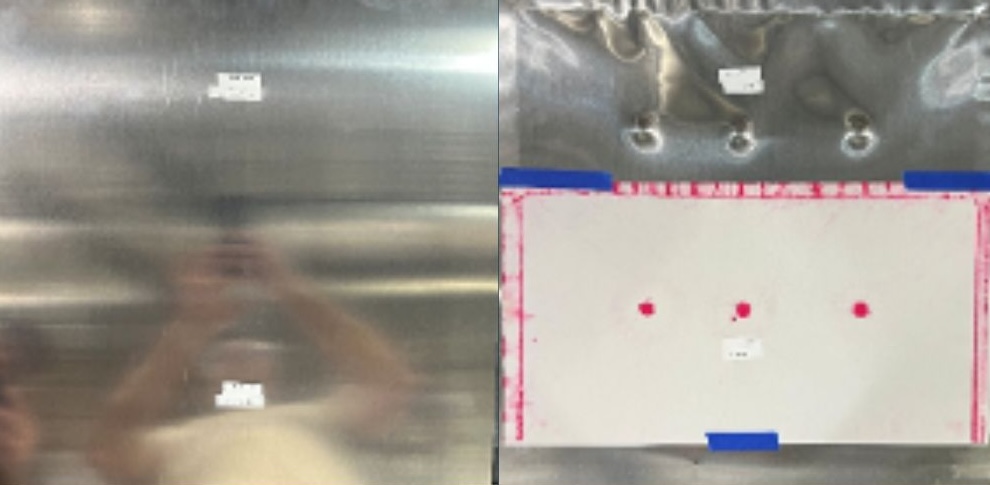
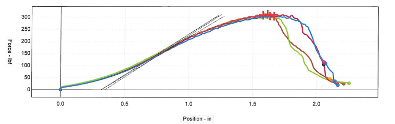
To better understand the potential damage from a hailstorm and engineer a solution against it, the Transhield engineering team performed material tests according to ASTM F320, the Standard Test Method for Hail Impact Resistance of Aerospace Transparent Enclosures. The test was modified to run against 0.020-inch and 0.080-inch aircraft aluminum sheets with various impact-modifying materials. Tests were performed with 1-inch and 2-inch hail, from quarter size up to large hail bigger than a golf ball, at speeds between 45 mph and 72 mph, matching the real fall speeds of hail at those sizes.
The results were direct. Unprotected aircraft aluminum panels showed extreme dent damage. Panels protected with Transhield Hail Protective Covers showed no damage.
The HPC material has also been tested to ASTM D-4833, with no puncture damage observed at more than 340 pounds of applied force, while weighing only 1.66 pounds per square yard. That balance matters on a flight line: the cover has to absorb hailstone impact without adding weight or bulk that slows crews down during installation and removal.
Where Hail Protective Covers Fit
Transhield manufactures custom-fitted storage and transportation covers for a range of industries, and the Hail Protective Cover applies that same design process to hail-exposed assets. An HPC may be suitable for:
- Personal aircraft parked outside a hangar
- Commercial aircraft and ground support equipment on the ramp
- Military aircraft and support equipment on the ground
- Military ground vehicles and equipment in outdoor storage or staging
Because each cover is designed from the asset’s actual geometry, there are no loose sections for strong winds to catch and no gaps where wind-driven rain enters after the hail passes.
The same protection extends beyond aviation and defense where assets sit outdoors in hail-prone regions, but the design goal stays constant: effective protection from a tested, custom-fit layer between the storm and equipment that cannot be moved indoors.
Plan Before the Next Hail Event
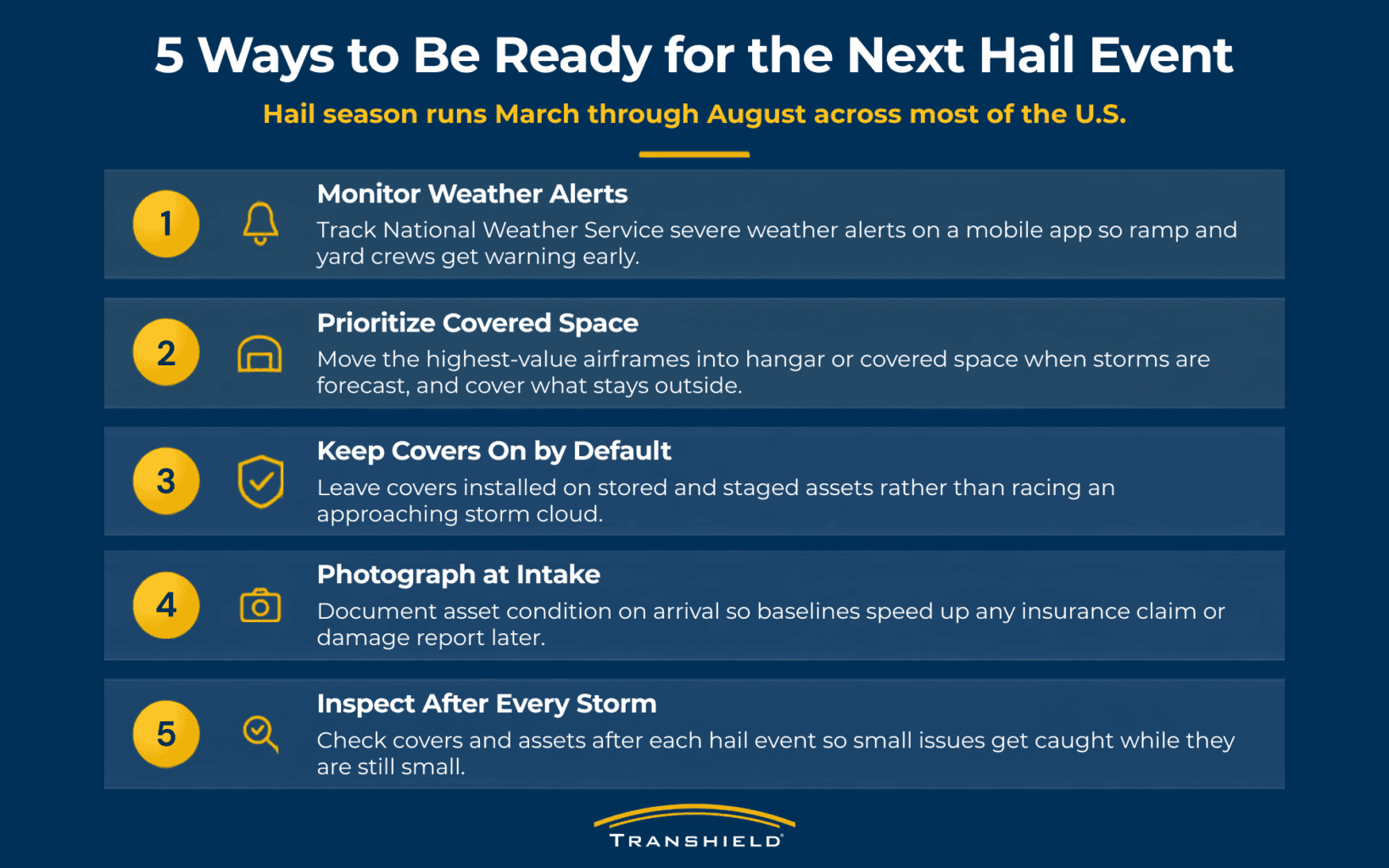
Hail season runs March through August across most of the U.S., and the highest-risk states are known well in advance. A few operational habits reduce the damage from any single storm:
- Monitor National Weather Service severe weather alerts through a weather mobile app so ramp and yard crews get warning before a severe storm arrives.
- Prioritize hangar space or any covered area for the highest-value airframes when storms are forecast, and cover what stays outside.
- Keep covers installed on stored and staged assets by default rather than racing an approaching storm cloud.
- Photograph asset condition at intake so documented baselines speed up any insurance claim or damage report.
- Inspect covers and assets after each hail event so small issues get caught early.
Protect Your Assets on the Ground
Hail damage is predictable enough to plan for and expensive enough to justify the effort. Transhield has spent over 30 years designing custom protective covers for aviation, military, and industrial customers, with tested materials and a design process that fits any shape or size of asset.
For further technical or sales information, contact Transhield at www.transhield-usa.com.