
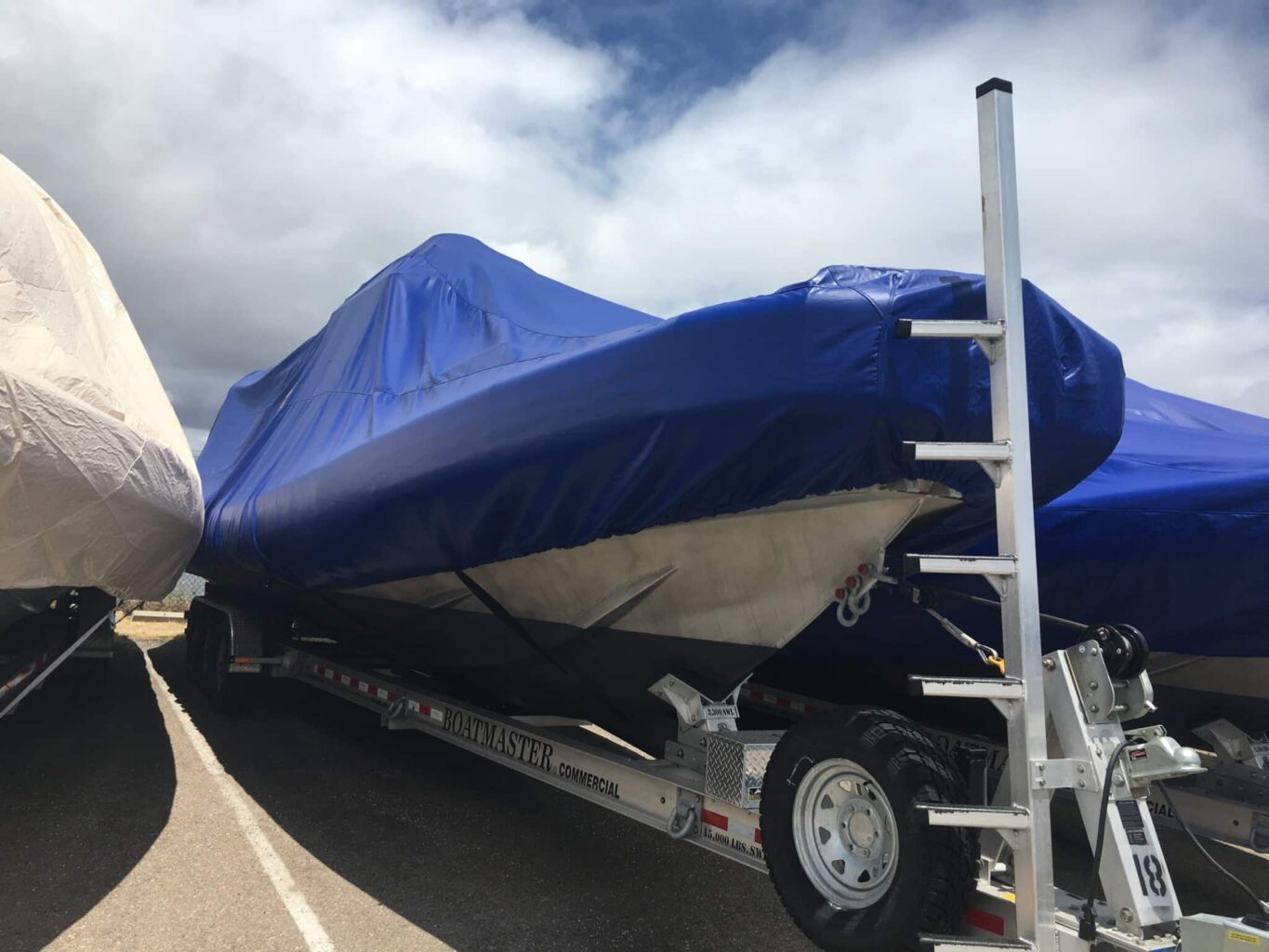
Military ground vehicles, naval deck equipment, and high-value industrial machinery often sit exposed for months before they are deployed or shipped. During that wait, corrosion, mold, mildew, UV radiation, water intrusion, and wind all work against them. A protective cover is only as reliable as the fabric it is made from, and the only way to know a fabric will perform is to measure it.
ArmorDillo is the proprietary fabric we engineer for these conditions, custom-tailored to the equipment it protects across the military and industrial sectors. We test every roll in our own laboratory before it becomes a cover, and peel strength is one of the most revealing tests it faces.
What ArmorDillo Fabric Is Built to Do
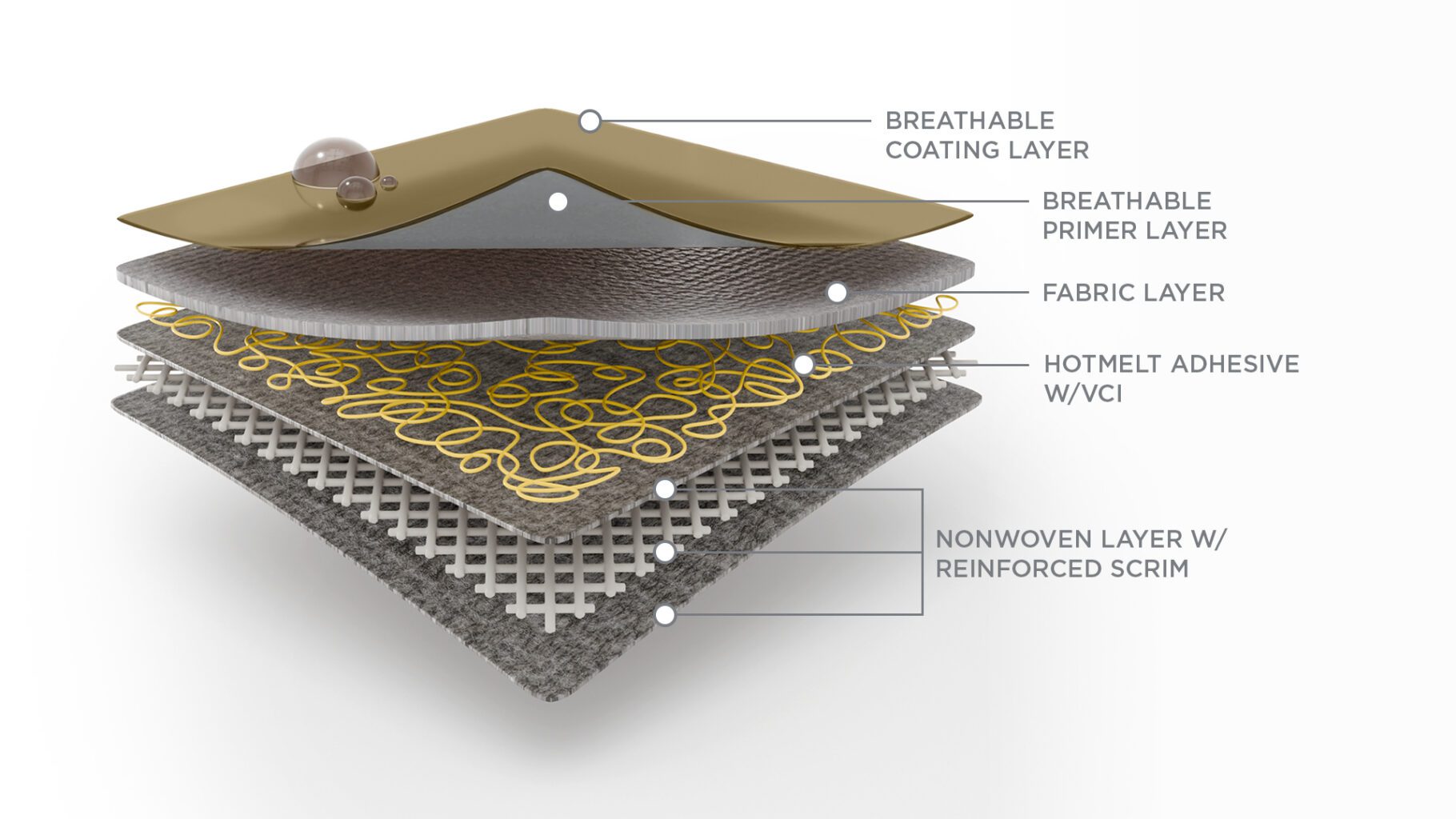
We engineer ArmorDillo to slow corrosion and shield equipment from harsh environments, including the salt and spray of marine settings. Its performance comes from a three-layer construction:
- The outer layer is a UV-resistant polyethylene film that blocks sunlight and repels water.
- The middle layer is a solvent-free hot-melt adhesive. A patented version of this adhesive emits Vapor Corrosion Inhibitor (VCI) molecules to fight rust.
- The inner layer is a soft, non-woven material that wicks moisture away from equipment and protects painted surfaces from scratching.
Covers that include VCI technology reduce corrosion by up to 95%. The VCI works by maintaining a concentration of protective molecules in the space around the metal, reaching recessed areas and complex shapes that direct coatings miss. A cover can only deliver that protection if its three layers stay bonded together, which is exactly what peel testing confirms.
Why Peel Strength Matters
The peel adhesion test measures the strength of the bond between the non-woven material and the film, the glue strength produced during lamination. When that bond is weak, the fabric can delaminate, or peel apart, once it is in the field. A delaminated cover stops doing its job and leaves the asset underneath exposed.
High peel strength is required for the conditions military and industrial equipment face: wide temperature swings, high and low humidity, intense UV, and the rough handling common in demanding service. Peel testing also confirms that the amount of adhesive per square inch stays within spec. Too much glue adds weight and reduces pliability, and we want a lightweight fabric that one or two people can apply. Consistent lamination also keeps VCI distributed evenly across the fabric, so protection stays uniform from edge to edge.
How We Test ArmorDillo Peel Strength
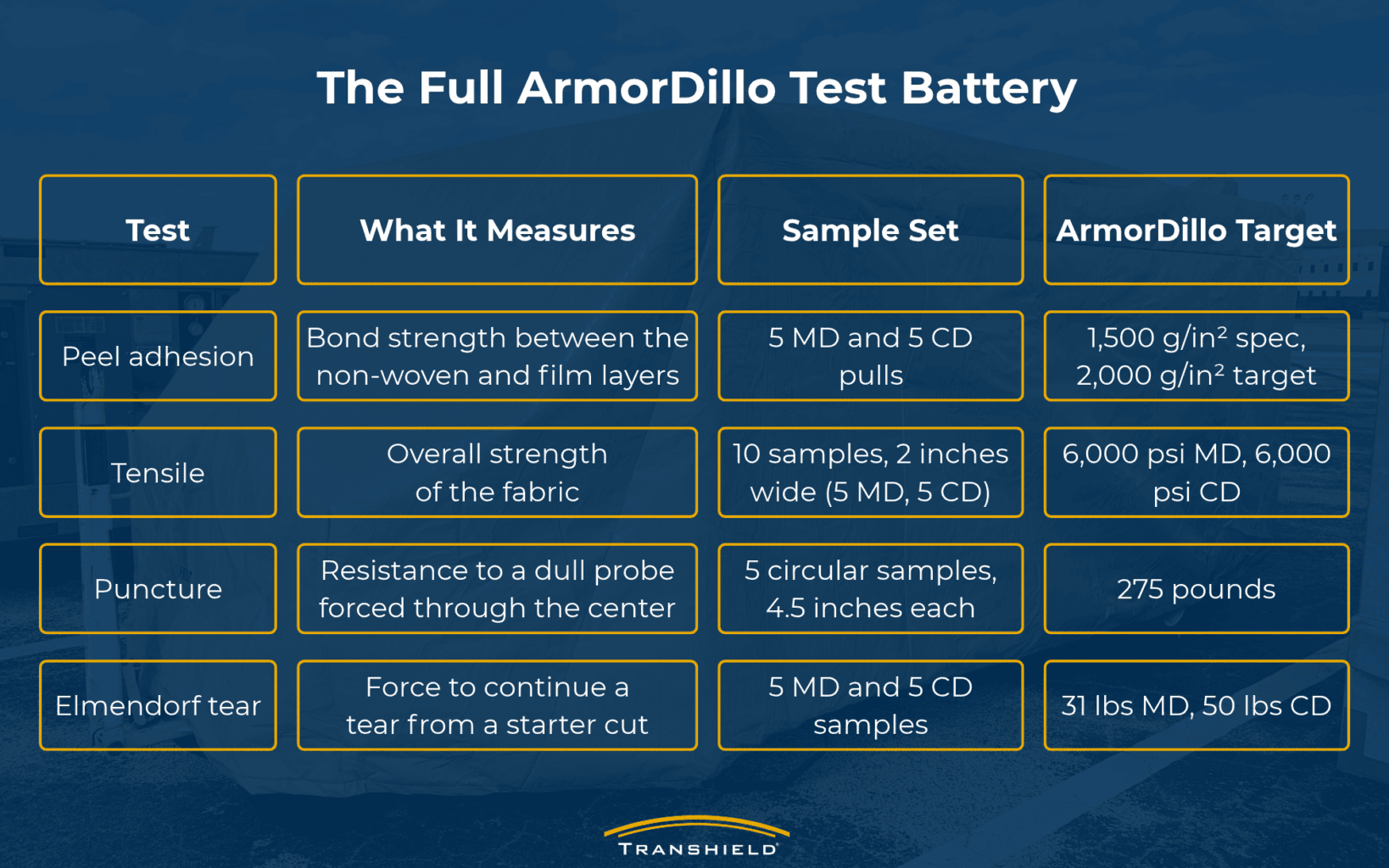
To run the peel test, we place the fabric in a system that performs five pulls in the machine direction (MD) and five in the cross direction (CD). The machine direction follows the fabric as it runs off the production line, and the cross direction runs across its width.
ArmorDillo carries a peel strength specification of 1,500 grams per square inch, and we aim for 2,000 grams per square inch. When a measured result falls below the 1,500 gram spec, we trace the roll back to its source and remove it from production. Fabric that would fail in the field never becomes a cover.
The Full ArmorDillo Test Battery
Peel strength is one of four strength-based laboratory tests we run on ArmorDillo. Together, they measure how the fabric holds up to pulling, stretching, puncturing, and tearing.
Tensile Strength
Tensile testing measures the strength of the fabric as a whole. We cut ten two-inch-wide samples, five in the machine direction and five in the cross direction, then pull them apart to record the pressure the material can withstand. ArmorDillo is rated at 6,000 psi in both the machine and cross directions.
Puncture Resistance
Puncture testing uses five circular samples, each measuring 4.5 inches. We clamp down each sample while a single dull-ended probe presses through its center. ArmorDillo is rated at 275 pounds of puncture resistance.
Elmendorf Tear
The Elmendorf tear test starts with a small cut at the bottom of a clamped sample. A pendulum swings through the fabric and records the force required to continue the tear. We measure five machine-direction and five cross-direction samples, and ArmorDillo is rated at 31 pounds MD and 50 pounds CD.
What the Results Mean for B2B and B2G Buyers
For purchasing teams, packaging engineers, and program managers, this testing program is the difference between a cover that performs and one that fails on an expensive asset. Several points stand out.
- We test every roll rather than a random sample, so buyers ordering hundreds of identical covers receive consistent fabric across the entire run.
- We trace and eliminate below-spec rolls, catching weak fabric in the lab rather than on a vehicle or a flight line.
- We back ArmorDillo with certified quality systems, holding ISO 9001:2015 certification across three locations.
- Our military covers comply with the Berry Amendment, and we make every one of them in the USA.
- Branches of the US Armed Forces, in particular the Navy, rely on ArmorDillo to keep assets mission-ready.
Ready to Put ArmorDillo to Work
We have spent more than 30 years, since 1994, engineering protective covers for defense, marine, and industrial customers, and that focus shows in our 97.4% customer retention rate. We manufacture ArmorDillo in America from patented material built to withstand extreme conditions, and every roll earns its place through the laboratory tests above.
To find the right protective cover for your fleet or program, connect with our team.